What International Students Actually Eat at Maharashtra Universities
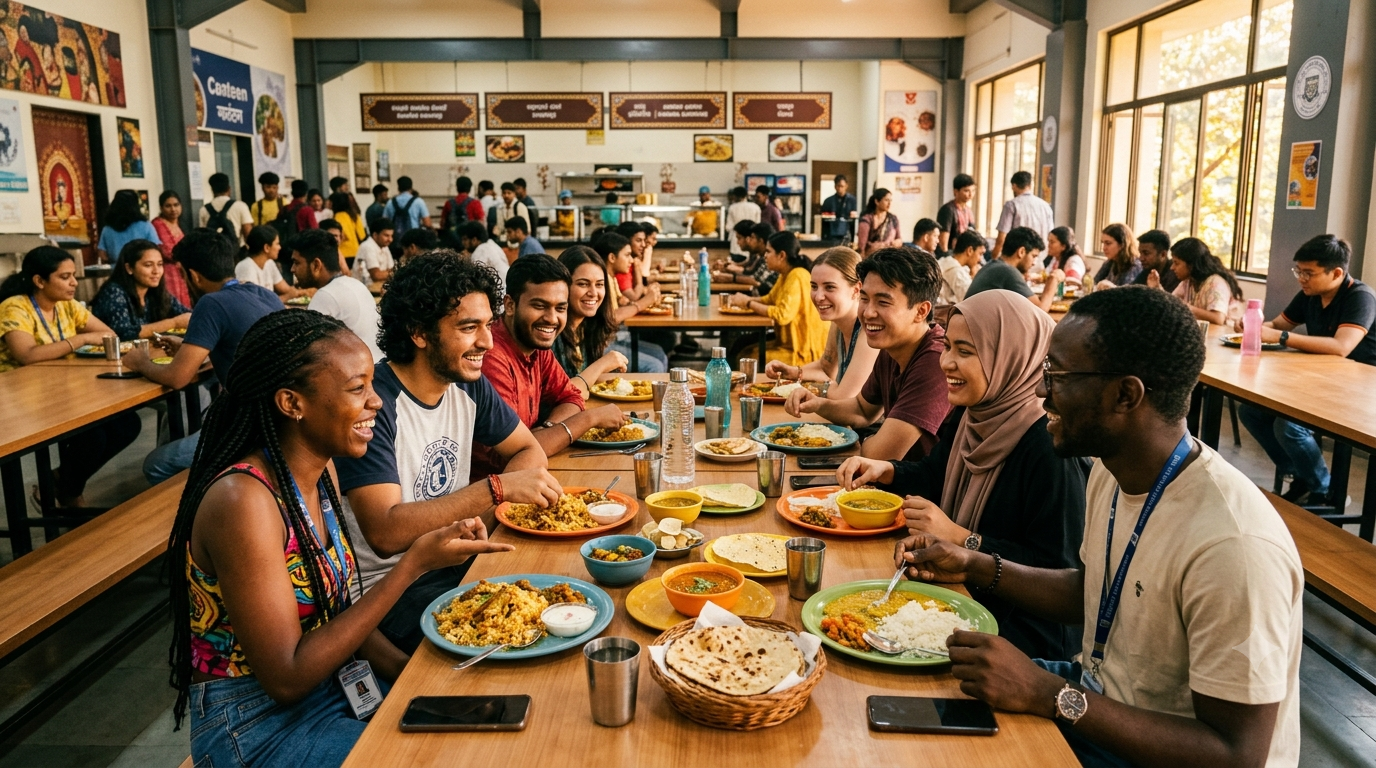
It's Just a Tuesday Lunch — and the Canteen is Packed with 30 Nations
A Nigerian student piles his plate with dal chawal. A Sri Lankan girl debates raita vs chutney. A Bangladeshi student laughs with his Emirati classmate over steaming biryani. This is not a food festival. This is a regular Tuesday at a Maharashtra university. Here is what campus life, food, and belonging really looks like for international students in Maharashtra.
The Scene at the Canteen — and Why It Matters
It is 1:15 PM on an ordinary Tuesday. The university canteen smells of fresh rotis coming off the tawa, of cumin-tempered dal, of something frying in the back. The plastic chairs are full. A student from Nigeria is on his second helping. A group from Sri Lanka is debating whether the campus biryani beats what they had last Friday. Two students from Bangladesh are explaining sambhar to a classmate from the UAE who is tasting it for the first time.
Nobody is performing diversity. Nobody is making a speech about global education. They are just having lunch.
This is what Maharashtra's international student environment looks like from the inside. Students from over 30 countries arrive each year through the official fn.mahacet.org portal, and what they find is not just a degree. They find a community, a culture, and yes, very good food.
"I thought the food would be a problem for me. It is not a problem at all. There is always rice, always something with vegetables, always something spicy if you want it. The canteen people know us now."
International student perspective — Maharashtra university campus
Food is not a small thing when you are far from home. It is the most immediate, daily signal that you belong, or that you do not. Maharashtra, with its cosmopolitan campus culture and Marathi-meets-Indian food traditions, lands on the right side of that question for most international students.
Who Is Already Here
Maharashtra is not a new destination for international students. It has been quietly building one of India's most diverse international student communities for over a decade. The range of countries represented on Maharashtra campuses is broader than most students expect before they arrive.
This matters beyond the statistics. When a student from Nigeria arrives on campus and finds three seniors from Lagos who graduated last year and went back to practice medicine, the decision to come becomes easier. The community already exists. The path is already lit.
What International Students Actually Eat
Maharashtra's food culture is built around rice, lentils, vegetables, flatbreads, and a deeply flavourful spice tradition that feels familiar to students from South Asia, West Africa, the Gulf, and Southeast Asia alike. The transition, for most students, is less dramatic than they feared.
Most university canteens serve both vegetarian and non-vegetarian options. Chicken and egg dishes are widely available. Students from Muslim-majority countries find halal food options in and around most campus towns, particularly in Pune, Mumbai, and Aurangabad. Campus messes often accommodate dietary requests with a conversation and a little patience.
Why They Chose Maharashtra
The food is a metaphor. Students from Nigeria, Sri Lanka, Bangladesh, and the UAE are not coming to Maharashtra primarily for the canteen. They are coming because Maharashtra offers something that is genuinely rare: world-class, English-medium professional degrees at costs that do not require a family to liquidate its savings.
Engineering degrees at AICTE-approved Maharashtra colleges run from approximately INR 1 to 5 Lakh per year. MBBS, the most sought-after degree among international students from Nigeria, Ghana, and Sri Lanka, runs from INR 10 to 35 Lakh across five and a half years. For context, a comparable medical degree in the UK, USA, or Australia costs between USD 150,000 and USD 350,000 in total. In Maharashtra, the total cost including living is a fraction of that.
Then there is the MHT-CET exemption, which many prospective students do not know about until they visit fn.mahacet.org. Foreign National students, NRI students, OCI/PIO students, and CIWGC students are all exempt from the Maharashtra Common Entrance Test. They apply directly through the state portal. No entrance exam. No coaching classes. Just their school qualifications and a completed registration.
Fee Structure for International Students in 2026-27
Fees vary by course and institution. The registration fee paid to the State CET Cell via fn.mahacet.org is a one-time amount of USD $1,200, split as USD $50 provisional fee upfront and USD $1,150 after the provisional eligibility letter is issued. College tuition is paid separately and directly to the institution.
Fee Structure for International Students — 2026-27
INR fees + USD $1,200 one-time registration via fn.mahacet.org
* Annual fee ranges across Maharashtra colleges. College tuition paid separately to institution. Source: fn.mahacet.org and studyinmaharashtra.org
How to Apply: From Canteen Dream to Campus Seat
The application process for international students is handled entirely through fn.mahacet.org, which is the official State CET Cell portal for Foreign National, NRI, OCI, PIO, CIWGC, and Merchant Navy category students. The process is online and straightforward.
The student first identifies their category (Foreign National if they hold a non-Indian passport, NRI if they are an Indian citizen residing abroad, OCI/PIO if they hold those documents, or CIWGC if their parent works in a Gulf country). The category check tool at fn.mahacet.org/category-check helps with this.
Application Timeline for 2026-27 Intake
The First Week: What Smart Students Do
The first week in Maharashtra sets the tone for the next three to five years. Students who arrive prepared and move through the practical steps quickly are the ones who settle in fastest and start enjoying the experience, including the food, the friends, and the city, within the first few weeks.
Your First Week in Maharashtra — Checklist
What the Degree Gets You Back Home
A degree from an AICTE or UGC-approved Maharashtra institution is a recognised professional qualification. India's higher education system, governed by the University Grants Commission and the All India Council for Technical Education, produces graduates whose credentials are assessed and accepted by professional bodies and employers across Africa, the Gulf, South Asia, and Southeast Asia.
MBBS graduates from Maharashtra medical colleges sit licensing exams in their home countries and enter medical practice. Engineering graduates from AICTE-approved institutions are assessed by engineering bodies in their countries. MBA graduates from institutions with AICTE or university affiliation enter management roles with credentials that transfer.
The attestation trail for foreign students, where required, follows a standard path: State HRD Department to Ministry of External Affairs apostille to home country embassy attestation. The college's international student office typically guides students through this process at graduation.
Frequently Asked Questions
The Bigger Picture
It is easy to talk about Maharashtra in terms of statistics: 700+ colleges, 68 countries represented, fees from USD $1,200 per year, no entrance exam for international students. The numbers are real and they matter.
But the thing that makes Maharashtra stick in the memory of students who came here from Lagos, Colombo, Dhaka, Dubai, or Bangkok is simpler than any of that. It is the Tuesday lunch. The packed canteen. The classmate from a country you had never met anyone from before. The plate of food that tasted almost like home and slightly better than expected.
Maharashtra is India's education powerhouse and its most globally connected state. If you are thinking about studying in India, this is where you want to be. Check your eligibility and start your application free at fn.mahacet.org.
Your seat at a Maharashtra university is closer than you think. Check your eligibility, explore 50+ courses, and begin your application — completely free.
Check Eligibility Free at fn.mahacet.orgQuestions? Email: student@mahacet.org | Helpline: +91-9076000348 (Mon–Fri, 10 AM–6 PM IST)