Australia Refused 35% of Afghan Student Visa Applications. India's Bilateral Arrangement Makes It Comparatively Accessible.

Australia's student visa refusal rate for Afghan applicants stands at 35 percent. More than one in three Afghan students who applied for an Australian student visa was refused. For a destination that many Afghan families have traditionally considered a strong study-abroad option, this number represents a significant and practical barrier.
India, by contrast, operates under a longstanding bilateral arrangement with Afghanistan that makes the visa process comparatively accessible. Afghan nationals apply for an Indian visa through the Indian Embassy, paying the applicable standard charges. The process is established, the requirements are standard, and the refusal picture is significantly better than what Australian visa statistics show for Afghan applicants.
For Afghan students comparing their international study options, these numbers matter. This article covers the India visa process for Afghan nationals, what documents are needed, and how to apply to Maharashtra's institutions through fn.mahacet.org once the visa is in place.
The Australia Situation for Afghan Students
A 35 percent refusal rate means that roughly one in three Afghan students applying for an Australian student visa is refused. The reasons for individual refusals vary and include the assessment of genuine temporary entrant status, financial documentation, ties to home country, and the broader immigration risk framework that Australian visa processing applies. Individual circumstances determine individual outcomes, but the aggregate statistic tells a clear story about the difficulty of this pathway for Afghan applicants.
For students who have invested time, money, and expectation in an Australian application only to receive a refusal, the impact is significant. For students still in the planning stage, it is important information. A 35 percent refusal rate means the risk of a failed application is real and should be factored into any decision about where to pursue higher education.
India offers a different picture. The bilateral relationship between India and Afghanistan has deep historical and diplomatic roots, and the visa arrangements for Afghan nationals reflect a more accessible framework than what Australian visa statistics show.
India and Afghanistan : The Bilateral Arrangement
India and Afghanistan share a longstanding bilateral relationship built across decades of diplomatic, cultural, and educational exchange. India has been one of Afghanistan's most significant development partners, and the two countries have maintained strong people-to-people connections across generations.
Under the bilateral arrangement, Afghan nationals apply for Indian visas through the Indian Embassy. The process involves paying the applicable standard government charges : unlike the Bangladesh arrangement where visas are issued free of charge, Afghan nationals pay the standard visa charges as part of their application. However, the process is established, the requirements are standard, and the visa pathway is accessible in a way that compares favourably to what Afghan applicants face when applying to Australia or other Western countries.
The Indian Embassy is the processing channel for Afghan national visa applications. Afghan students seeking to study in India apply through this channel, submit the required documents, pay the applicable charges, and receive their visa decision through the Embassy.
Documents Required : Standard Requirements
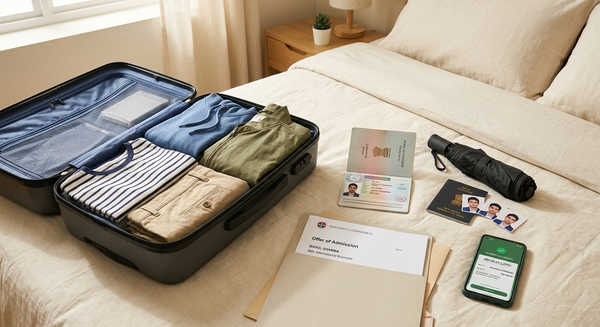
The documents required for an Indian student visa application for Afghan nationals follow the standard visa application requirements. Students should verify the current specific requirements directly with the Indian Embassy before preparing their application, as requirements can be updated. The standard documentation for an Indian student visa application includes:
A valid Afghan passport with sufficient validity remaining for the duration of the intended study period. The passport should have at least six months of validity beyond the intended stay.
A completed visa application form, filled accurately and completely through the official Indian visa application process. The form must be filled without errors or inconsistencies.
Proof of admission from the Indian institution where the student has been accepted. For students applying through fn.mahacet.org, this is the offer letter or provisional admission letter generated by the portal after the application and fee payment process is completed.
Financial documents demonstrating that the applicant has sufficient funds to support themselves during their period of study in India. This typically includes bank statements from the student's own account or from the supporting family member's account, showing adequate financial capacity.
Academic certificates confirming the student's educational qualifications : 12th grade results, school leaving certificate, or equivalent qualification depending on the program applied for.
Preparing these documents carefully and completely before submitting to the Indian Embassy is the most important practical step in the visa process. Incomplete or inconsistent documentation is the most common cause of delays. Students should review their application thoroughly before submission.
fn.mahacet.org : Maharashtra's Official Portal for International Students
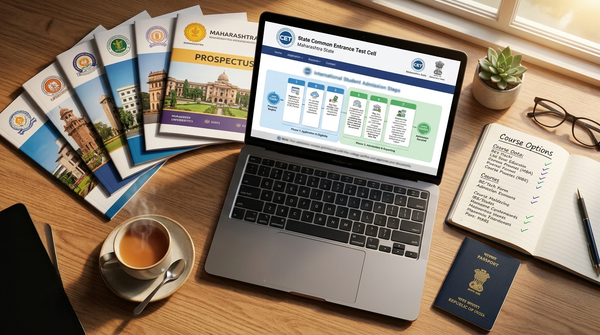
Once the Indian student visa is in place, the admission process for Maharashtra's institutions is through fn.mahacet.org : the Government of Maharashtra's official Foreign Candidate Registration Portal, operated by the State Common Entrance Test Cell, Government of Maharashtra.
fn.mahacet.org is not a private company, not a consultancy, and not an agent. It is the Government of Maharashtra's own portal for processing international student admissions across Maharashtra's 6,000 plus institutions. Every program listed on the portal is government-verified. Every fee is government-regulated.
The portal covers programs across every level and discipline: Engineering (Bachelor of Engineering/Technology), Pharmacy (B.Pharm and Pharm D), Planning (Bachelor of Planning), Hotel Management (B.HMCT), Law (L.L.B.), Education (B.A.-B.Ed. and B.Sc.-B.Ed.), Medical Education, and more. Afghan students browse programs using the search filters on the portal, selecting their level, course name, and specialization to see which institutions across Maharashtra offer that program.
The portal fees for international students are fixed: USD 50 for the eligibility fee and USD 1,150 for the processing fee. Both are non-refundable and listed on the portal before any payment is made. There are no additional charges. No agent commission on top. No hidden amounts. Just the two fixed government fees.
The 15% Supernumerary Quota for International Students
Afghan students applying through fn.mahacet.org enter a 15 percent supernumerary quota reserved specifically for Foreign National Students, NRI, OCI, PIO, and CIWGC candidates. This quota is separate from the seats filled through the domestic Maharashtra admission process.
Afghan students are not competing against the large domestic Indian student pool. Their 12th grade marks are assessed against other international applicants within the same quota. This is a meaningful distinction : the competition pool is appropriately scoped for international candidates, and the merit list is compiled specifically from international applicants' academic documents.
No MHT-CET Required
One point that every Afghan student researching India needs to understand clearly: international students are not required to sit MHT-CET : the Maharashtra Common Entrance Test. This is confirmed in the MHT-CET 2026 Information Brochure published by the State Common Entrance Test Cell, Government of Maharashtra. Section 4, Point 4 of that brochure states explicitly that Foreign Nationals, NRI, OCI, PIO, and Children of Indian workers in Gulf countries are exempted from appearing for MHT-CET 2026.
For Engineering, Pharmacy, and Planning programs, admission for international students is based on 12th grade marks only. No entrance exam is required beyond what the student already has from their own schooling.
Academic Requirements for Key Programs
For Engineering (Bachelor of Engineering/Technology): Physics and Mathematics as compulsory 12th grade subjects, plus one additional science subject, with a minimum 45 percent aggregate. No entrance exam.
For Pharmacy (B.Pharm): English plus Physics, Chemistry, and Mathematics or Biology in 12th grade. No entrance exam.
For Pharm D (Doctor of Pharmacy): Physics and Chemistry with Mathematics or Biology in 12th grade. No entrance exam.
For Planning (Bachelor of Planning): Mathematics as a compulsory 12th grade subject with two additional relevant subjects and a minimum 45 percent aggregate. No entrance exam.
For Medical Education (MBBS and Ayush programs): NEET qualification is mandatory.
For Architecture (B.Arch): NATA qualification is mandatory.
All other confirmed programs on fn.mahacet.org are based on 12th grade marks. Afghan students with completed 12th grade qualifications in the relevant subjects are academically eligible to apply for the programs that match their subject combination.
Farid's Conclusion
Farid compared the numbers before he made his decision. Australia: 35 percent refusal rate for Afghan applicants. India: a bilateral arrangement, an established visa process through the Indian Embassy, standard charges, and a direct government portal on the other side : fn.mahacet.org : giving access to 6,000 plus institutions across Maharashtra.
The comparison was clear. He applied through fn.mahacet.org. He is now studying in Maharashtra. His message to every Afghan student still weighing options: look at the numbers, prepare your documents properly, apply through the Indian Embassy, and use fn.mahacet.org. The process is established. The institutions are real. The pathway is more accessible than the Australia statistics suggest for Afghan applicants.
fn.mahacet.org. India-Afghanistan bilateral arrangement. The pathway exists. Use it.
Frequently Asked Questions
How does the India-Afghanistan bilateral visa arrangement work for Afghan students?
Under the bilateral arrangement between India and Afghanistan, Afghan nationals apply for Indian visas through the Indian Embassy. Standard government charges apply. The required documents follow the standard Indian visa application requirements including a valid passport, completed application form, proof of admission from the Indian institution, financial support documents, and academic certificates. Students should verify the current specific requirements directly with the Indian Embassy before preparing their application. Once the visa is in place, admission to Maharashtra institutions is through fn.mahacet.org.
How does an Afghan student apply to Maharashtra institutions through fn.mahacet.org?
Afghan students apply as Foreign National Students through fn.mahacet.org. They use the category checker at fn.mahacet.org/category-check to confirm eligibility, browse programs using the search filters, upload documents, and pay the fixed portal fees of USD 50 eligibility and USD 1,150 processing. No entrance exam is required for Engineering, Pharmacy, Planning, Hotel Management, Law, and Education programs. The offer letter arrives through the portal. FRRO registration must be completed within 14 days of arrival in India. The helpline at +91-9152252049 (10am-6pm IST) and student@mahacet.org are available throughout the process.
Ready to apply?
Maharashtra is India's most connected state for international students. 6,000+ institutions. Every confirmed program. One government-backed portal. No agents. No middlemen.
Apply now at fn.mahacet.org/ : the official Government of Maharashtra portal.
Follow us: