Inside the Hostel: What Bahraini Students Actually Find When They Arrive in Maharashtra
Tariq did a room tour on his second day. Not for social media, for his mother. He walked around the hostel room in Pune with his phone, narrating in Arabic, showing her the bed, the desk, the wardrobe, the window view, the bathroom down the corridor. She watched it four times. The question every Bahraini family asks before their student boards a flight is the same question: what is the room actually like, and will my child be comfortable and safe there? This article answers that properly, without the brochure version.
The Room: What Is Actually Included
Maharashtra university hostels typically provide single or shared rooms depending on the institution and the year of study. Most first-year international students are placed in shared double rooms, with single rooms becoming available in later years either through seniority or at additional cost.
A standard room includes a bed with mattress, a study desk and chair, a wardrobe or cupboard for storage, and ceiling or wall fan. Air conditioning is not standard in most government hostel blocks, though newer private institution hostels often include it. Students arriving from Bahrain in June or July, which covers the hottest and most humid part of the Pune year, should factor this in and budget for a personal fan or portable air cooler if their hostel does not provide one.
Attached bathrooms are not universal. Many hostel blocks operate shared bathroom facilities on each floor, kept on a cleaning roster. The upkeep varies meaningfully between institutions. Students should ask specifically about bathroom arrangements and cleaning schedules when they receive their hostel allocation, not after they arrive.
What the room does reliably provide is a functional, quiet study space. Maharashtra university hostels enforce quiet hours, usually from 10 PM, and the study environment is taken seriously. Students who came expecting a dormitory party culture are consistently surprised by how seriously the hostel population treats academic work.
Halal Food: Canteen Availability and Options
This is the question Bahraini families ask most often after accommodation, and the answer is more positive than many expect.
Maharashtra has a large Muslim population, particularly in Mumbai and Pune, and halal food is genuinely available rather than an edge-case accommodation. Many university canteens in Maharashtra serve halal-certified meat, and institutions with significant international student populations from Gulf countries have often formalised halal options in their dining facilities.
Where the main canteen does not offer halal meat, there are reliable alternatives within reach. Pune and Mumbai both have halal restaurants, street food vendors, and grocery shops within walking or short auto-rickshaw distance of most campuses. Students typically settle into a routine within the first two weeks, identifying which canteen counters and which nearby restaurants meet their dietary requirements.
The honest note: verify the halal status of your specific institution's canteen before you arrive. Ask your college's international student coordinator directly. Do not assume. Most institutions with Gulf student populations have this sorted, but it is worth confirming rather than discovering on day one.
Prayer Facilities: On Campus and in the Hostel
Pune and Mumbai have well-established Muslim communities and functioning mosque infrastructure. Most areas near major universities have a neighbourhood mosque within a short distance, and Friday Jumu'ah is accessible without significant travel for students at most Maharashtra institutions.
On-campus prayer arrangements vary. Some larger institutions have dedicated prayer rooms within the campus or hostel block. Others rely on students using a corner of a common room or their own hostel room for daily prayers. Students arriving for the first time should identify the nearest mosque to their campus in advance using Google Maps and locate a clean, usable space in their hostel room as their default.
The student community helps here. Bahraini students who arrived before you have already mapped this. The Gulf student WhatsApp groups that form in most Maharashtra universities within the first week of term share prayer room locations, mosque timetables, and practical navigation information that no official orientation covers.
Security: 24-Hour Access, Electronic Entry, and CCTV
Maharashtra university hostels operate structured security arrangements. Most hostel blocks have a warden or security guard stationed at the entrance around the clock. Entry after designated hours, typically 10 PM to 11 PM for most institutions, requires sign-in and sometimes prior permission. This feels restrictive to some students initially and reassuring to most parents immediately.
Newer hostel buildings and those at private institutions increasingly use electronic access cards for room and building entry. CCTV coverage of common areas, stairwells, and entrances is standard at most institutions in Pune and Mumbai. Visitors, including family members, are required to sign in at the reception and are not permitted in residential floors beyond set visiting hours.
The security culture in Maharashtra student hostels is campus-in-loco-parentis in structure. Students living away from home for the first time generally find the boundaries clarifying rather than restrictive once they are settled. Parents find them reassuring almost universally.
Wi-Fi and Staying Connected with Bahrain
This is non-negotiable for most students and it is largely sorted. Maharashtra university campuses are broadly covered by campus Wi-Fi, and the quality has improved significantly over the last three years as institutions upgraded infrastructure. Speeds vary, and peak-hour congestion in hostel common areas can slow connections during evenings.
The practical solution most students arrive at quickly is a personal Indian SIM card with a data plan. Jio and Airtel both offer student-friendly prepaid plans with substantial data allowances at low monthly cost. An Indian SIM can be set up within the first week with passport and visa documentation, and it provides personal 4G or 5G connectivity independent of hostel Wi-Fi.
WhatsApp, FaceTime, and video calls with Bahrain run without issue on either campus Wi-Fi or an Indian data plan. Students maintaining regular contact with family find the connection reliable enough for daily calls. Tariq talks to his mother every evening. She still sometimes asks him to do a room tour.
The Community: Who Is on Your Floor
Maharashtra's status as India's most internationalised state for higher education means the hostel population at most Pune and Mumbai universities is genuinely diverse. Gulf students, specifically from Bahrain, Saudi Arabia, Kuwait, and the UAE, form a consistent presence at institutions that have invested in international recruitment. Students from Nepal, Bangladesh, Sri Lanka, Nigeria, Ethiopia, and East Africa are also common depending on the institution.
This matters practically. Students arriving from Bahrain almost always find someone from the Gulf region already on their floor or in their programme. The social orientation period is shorter than it would be at a university with a purely domestic student population.
Indian students in the same hostel are typically curious about Gulf students and generous with local knowledge. Within a few weeks, most Bahraini students have a working social network that spans Gulf, South Asian, and African international students alongside domestic students from Maharashtra, Gujarat, and other Indian states. The mix is one of the things students consistently mention when they talk about what they did not expect to value.
FAQ
Can parents visit the hostel?
Yes. Maharashtra university hostels permit family visitors during designated visiting hours, typically in the afternoon and early evening on weekdays and with slightly extended hours on weekends. Visitors sign in at the reception and are hosted in common areas or designated visitor rooms rather than in residential corridors. Parents travelling from Bahrain for a visit should notify the hostel warden in advance, both out of courtesy and to ensure smooth entry. Accommodation for visiting parents is best arranged at a nearby hotel or guesthouse rather than on campus, as guest staying facilities within hostels are limited and not uniformly available. Most Pune and Mumbai neighbourhoods near university campuses have affordable, clean hotel options within a short auto-rickshaw ride.
Tariq's mother has seen that room from every angle now. She knows which window gets the afternoon light, which shelf he keeps his textbooks on, and where the mosque is relative to his hostel gate. The hostel is not a five-star hotel. It is a clean, functional, secure place to sleep and study, surrounded by students from across the world who are doing exactly the same thing he is.
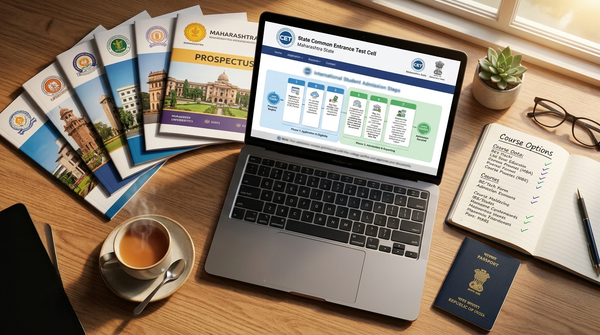
If you are ready to find out which hostel, which college, and which course, the place to start is the official Government of Maharashtra portal.
Apply at fn.mahacet.org. No agents. No middlemen.
Maharashtra is India's most connected state for international students. Over 3,000 colleges. Every discipline. One government-backed portal. No agents. No middlemen.
Apply now at fn.mahacet.org, the official Government of Maharashtra portal.
Follow us: Instagram: @admissiondeskedu YouTube: Edulab Educational Exchange Facebook: @admissiondeskedu