Jalil from Kandahar Spent Three Days on One Circuit Problem at G.S. Mandal's MIT. This Morning It Worked.

Jalil is from Kandahar, Afghanistan. He studies Electronics and Computer Engineering at G.S. Mandal's Maharashtra Institute of Technology. And this week, he spent three days on a single circuit problem that refused to cooperate.
The problem was in a signal processing circuit his group had designed. The output was wrong. The numbers were not matching the expected values. He checked the schematic once. He checked it again. He rebuilt part of the design. He ran the simulation. Still wrong.
On the third morning, sitting in the electronics lab before the other students arrived, he went through the circuit one more time. Slowly. Component by component. And there it was. One misconnected pin. One single wire going to the wrong place in the breadboard. He fixed it. He powered the circuit. The output was correct.
He sat there for a moment without saying anything.
That moment - quiet, in a lab in Maharashtra, with a circuit board that finally worked - is the result of a search he made on fn.mahacet.org, an application he submitted himself, and a decision he made alone in Kandahar about what he wanted to build.
Why Electronics and Computer Engineering
Jalil grew up in Kandahar at a time when reliable electricity was not a given. He watched what happened when power systems failed - businesses that could not run, hospitals that switched to generators, homes that adjusted their entire day around outages. He also watched, from a young age, the way small electronic devices kept working when larger systems failed. A radio running on batteries. A solar-powered lamp. A device that did not depend on the grid because someone had designed it not to.
He became interested in the design side. Not the wires coming from a power station, but the components sitting on a circuit board. The transistors, the resistors, the logic gates that control what happens when and how. The world inside the chip.
He started teaching himself basic electronics in secondary school. He borrowed books. He watched videos. He built small circuits on a breadboard with components he bought from a market in Kandahar. By the time he finished school, he knew what he wanted to study. He just needed to find where to study it.
How He Found fn.mahacet.org
Jalil had heard of India as a study destination in general terms. Several older students from Kandahar had gone to Indian universities. But the information he could find was fragmented - different universities, different processes, different agents each offering something different at a price. He did not know what was official and what was not.
Then someone mentioned fn.mahacet.org. He opened it.
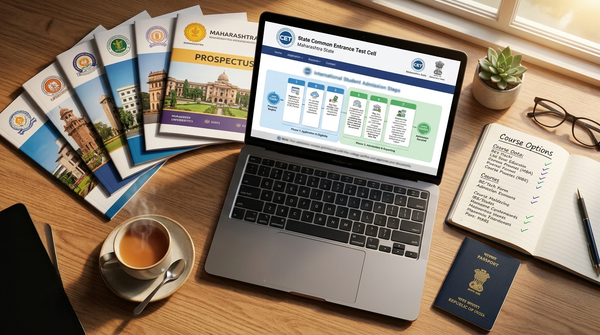
fn.mahacet.org is the Government of Maharashtra's official Foreign Candidate Registration Portal - a single-window platform operated by the State Common Entrance Test Cell, Government of Maharashtra. It is not a private company. It is not a consultancy. It is the government's direct portal for processing international student admissions across Maharashtra's 6,000+ institutions.
What Jalil found when he opened it was a search interface that was straightforward to use. He selected Bachelors under the Applying For field. He selected Bachelor of Engineering/Technology under Course Name. He selected Electronics and Computer Engineering under Specialization. The portal returned a list of institutes across Maharashtra offering this exact program. G.S. Mandal's Maharashtra Institute of Technology appeared in the results.
He read the institute details. He liked what he found. He selected it. He applied directly through the portal.
No agent was involved. No private consultant was paid. No WhatsApp number was messaged. Just Jalil, the government portal, and his academic documents.
G.S. Mandal's Maharashtra Institute of Technology
G.S. Mandal's Maharashtra Institute of Technology is an engineering institution operating under the G.S. Mandal trust. It offers Bachelor of Engineering/Technology programs across multiple specializations including Electronics and Computer Engineering.
Electronics and Computer Engineering is a specialization that sits at the intersection of two disciplines. On the electronics side: circuit design, signal processing, embedded systems, communication systems, sensors and actuators, power electronics. On the computer side: programming, computer architecture, operating systems, data structures, software engineering. The two sides are taught together because in practice they are inseparable. The firmware that runs a microcontroller is useless without the circuit it controls. The circuit is useless without the code that tells it what to do.
For Jalil, this combination was exactly what he had been working toward since he built his first circuit on a Kandahar market breadboard. He did not want only software. He did not want only hardware. He wanted both - the ability to design something from the component level up to the software layer.
The electronics laboratory at G.S. Mandal's MIT has the equipment to make this real. Oscilloscopes that display signal waveforms. Function generators. Multimeters. Microcontroller development boards. Soldering stations. The physical infrastructure of an engineering lab that takes its subject seriously.
What the Lab Actually Looks Like Day to Day
Jalil describes his typical lab session with the straightforward honesty of someone who has been doing this for a while now. You arrive. You check your bench. You review what you are supposed to demonstrate or build that session. You start working.
Sometimes things work on the first try. More often they do not. The gap between the circuit that exists in the simulation software and the circuit that exists on the actual breadboard is where most of the real learning happens. Simulations do not model everything. Components have tolerances. Connections have resistance. Real circuits behave slightly differently from the theoretical version.
The three-day circuit problem this week was a good example of this. In the simulation it had worked correctly. On the actual breadboard, the output was wrong. Something in the physical implementation differed from the model. Finding that difference - that one misconnected pin - required Jalil to understand both the theory and the physical reality well enough to know where to look.
That skill, the ability to move between the theoretical and the physical, between the schematic and the actual board, is what the Electronics and Computer Engineering program is building.
The Application Process - Exactly What It Involved
Jalil's application through fn.mahacet.org involved a clear sequence of steps.
He registered on the portal and confirmed his eligibility as a Foreign National Student using the category checker. He browsed the program listings using the search filters and identified G.S. Mandal's MIT as his preferred institute for Electronics and Computer Engineering.
He uploaded his required documents: his passport, his 12th grade academic certificates showing Physics and Mathematics as subjects, and a passport-size photograph. These are the standard documents required for the application.
He paid the eligibility fee of USD 50 through the CCAvenue payment gateway on the portal. Foreign currency is accepted. After his documents were verified and his eligibility was confirmed, he paid the processing fee of USD 1,150. Both amounts are fixed, government-regulated, and non-refundable. They are listed clearly on fn.mahacet.org before any payment is made. There are no additional charges beyond these amounts and the separate college fees, which are also listed on the portal per institution.
No entrance exam was required. International students applying through fn.mahacet.org for Bachelor of Engineering/Technology programs are not required to sit MHT-CET or any other Maharashtra state examination. The academic requirement is 12th grade marks in Physics and Mathematics, with one additional science subject, and a minimum of 45 percent in these subjects combined. Jalil had these results from his school in Kandahar.
His offer letter arrived through the portal. He completed FRRO registration within 14 days of arriving in India, as required for all foreign national students. Physical verification of his original documents happened at the institute. The whole process - from the first search on fn.mahacet.org to walking into the electronics lab - was structured, guided, and direct.
What He Would Tell Afghan Students Considering Engineering
Jalil's advice is practical and comes from experience rather than optimism.
First: decide what you actually want to build. Engineering has many branches. Civil engineering builds physical infrastructure. Mechanical engineering deals with machines and movement. Computer science is primarily software. Electronics and Computer Engineering specifically combines circuit-level hardware with programming. If you are interested in the design of electronic systems - devices, embedded controllers, signal processing, communications - then this is the right specialization. If you are not sure, think about what has interested you in the past. What problems have you tried to solve on your own? What have you taught yourself outside of school? The answer to those questions usually points toward the right branch.
Second: use fn.mahacet.org directly. Do not pay an agent to do something you can do yourself in one afternoon. The search filters on the portal let you browse by course, by specialization, and by institute. You can see which institutes offer your specific program before you commit to anything. The fees are listed before you pay. The process is guided step by step. An agent adds cost without adding value to a process that is already designed to be direct.
Third: prepare your 12th documents properly. Your marks in Physics and Mathematics are the academic basis for the Engineering application. Make sure your certificates are authentic, translated into English if necessary, and ready to upload. The portal's document requirements are listed clearly. Gather everything before you start the application rather than mid-process.
The lab work is difficult. The three-day circuit problem is not unusual - it is normal. But when it finally works, when the output matches the expected value and the theory becomes real in front of you, that is the reason you chose this subject. fn.mahacet.org.
Frequently Asked Questions
Does Electronics and Computer Engineering at G.S. Mandal's MIT require an entrance exam for international students?
No. International students applying through fn.mahacet.org for Bachelor of Engineering/Technology programs including Electronics and Computer Engineering are not required to sit any entrance exam. Admission is based on 12th grade marks in Physics and Mathematics, with one additional science subject, and a minimum of 45 percent in these subjects combined. The application is submitted directly through fn.mahacet.org as a Foreign National Student. The portal fees are USD 50 eligibility and USD 1,150 processing, both fixed, listed before payment, and non-refundable.
How does an Afghan student apply for Engineering at G.S. Mandal's MIT through fn.mahacet.org?
Open fn.mahacet.org and go to the Student Preferences or course search section. Under Applying For, select Bachelors. Under Course Name, select Bachelor of Engineering/Technology. Under Specialization, select Electronics and Computer Engineering. G.S. Mandal's Maharashtra Institute of Technology will appear in the results. Select it, upload your documents, pay the eligibility fee, and after confirmation pay the processing fee. The offer letter arrives through the portal. No agent is needed at any stage.
Maharashtra is India's most connected state for international students. 6,000+ institutions. Every confirmed program. One government-backed portal. No agents. No middlemen.
Apply now at fn.mahacet.org - the official Government of Maharashtra portal.
Follow us:
- Instagram: @admissiondeskedu
- YouTube: Edulab Educational Exchange
- Facebook: @admissiondeskedu