Khalid from Logar Had His First Moot Court Argument Yesterday at Government Law College, Mumbai. His Hands Were Shaking Before He Stood Up.

Khalid is from Logar, Afghanistan. He studies L.L.B. at Government Law College in Mumbai. And yesterday was his first moot court.
A moot court is a simulated court proceeding : a formal exercise where law students argue real legal cases in front of a judge, who is usually a faculty member or a practising lawyer. It is the moment when the law that students have spent months reading in textbooks becomes something they have to defend out loud, under questioning, without a script, in real time.
Khalid had prepared for two weeks. He had read the case file, researched the precedents, constructed his argument, and practised it. When the moment came to stand up, his hands were shaking.
He stood up anyway.
He stated his position. He cited the relevant statutes. He made his argument. His professor : sitting as judge : interrupted with questions Khalid had not anticipated. He answered them, one by one, finding the ground under each answer as he went. When he sat down, his hands had stopped shaking.
That experience : of having to defend a legal position out loud under pressure and coming through it : is what law school at Government Law College, Mumbai is building in him. He found the college himself, on fn.mahacet.org.
Why Law
Khalid grew up in Logar province in a community where legal disputes were a constant feature of daily life. Land boundaries. Inheritance disagreements. Contract disputes between farmers and buyers. Community conflicts that needed resolution. He watched what happened when people without legal knowledge tried to navigate these situations : how easily they were taken advantage of, how poorly they understood their own rights, how often the outcome of a dispute was determined not by what was right but by who had better connections or more money.
He decided early that he wanted to be someone who understood the law properly. Not as a set of abstract rules to be memorised, but as a system with an internal logic : a set of principles about how disputes between people are resolved when they cannot resolve them alone. He wanted to understand how that system worked and how to use it effectively on behalf of the people who needed it most.
Law was the subject. Government Law College was the institution.
Government Law College, Mumbai : What It Is
Government Law College, Mumbai, is one of India's oldest law colleges, established in 1855. It is a government institution : not a private law school : operating under the Government of Maharashtra. Its alumni list includes some of the most significant legal figures in Indian history, including B.R. Ambedkar, the principal architect of the Indian Constitution, who was a student at Government Law College in the early 20th century.
The institution's age and the depth of its alumni network are not merely matters of prestige. They reflect a continuous tradition of serious legal education in one of India's most active legal cities. Mumbai's courts : from the Bombay High Court downward : handle some of the most complex commercial, constitutional, and criminal cases in India. Government Law College students and graduates are embedded in that legal ecosystem through internships, court visits, and faculty who practise law alongside their teaching responsibilities.
The L.L.B. program at Government Law College is five years. It combines a Bachelor of Arts or equivalent undergraduate component with the law degree, covering the full range of legal subjects: constitutional law, contract law, criminal law, property law, family law, administrative law, evidence, civil procedure, criminal procedure, company law, and more. The five-year integrated format gives students a broader academic foundation alongside their legal training than a three-year post-graduate L.L.B. would provide.
For Khalid, who came from Logar specifically to get a serious legal education, the five-year program was what he wanted. He did not want a shortened version. He wanted the full training, the full curriculum, the full professional preparation. Government Law College provides it.
Mumbai as a Legal City
The location of Government Law College in Mumbai is directly relevant to the quality of the legal education it provides. Mumbai is the seat of the Bombay High Court, one of India's oldest and most respected courts, which has jurisdiction over Maharashtra, Goa, and the union territories of Dadra and Nagar Haveli and Daman and Diu.
The city's legal ecosystem is one of the most active in India. Commercial litigation involving some of the country's largest corporations. Constitutional cases that shape national policy. Criminal cases that set precedent. International arbitration. Intellectual property disputes arising from the country's entertainment and technology industries. Law students in Mumbai are not studying in an environment where the practice of law is distant or theoretical. They are studying in the city where Indian law is being actively made and argued.
Government Law College students have access to this ecosystem through the college's connections with the Bombay Bar. Internship placements with law firms, advocates, and courts are a feature of legal education at Government Law College that gives students practical exposure alongside their academic training.
For Khalid, who intends to return to Afghanistan and practise law there, the understanding of how a functioning legal system operates that Mumbai provides is genuinely relevant. Afghanistan's legal system is rebuilding. International law, constitutional frameworks, commercial law, dispute resolution mechanisms : all of these will matter. Understanding how they work in practice, not just in theory, is the preparation he is getting at Government Law College.
How He Found fn.mahacet.org
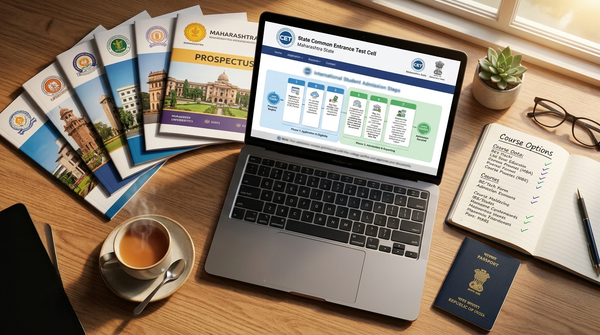
Khalid found Government Law College by searching fn.mahacet.org : the Government of Maharashtra's official Foreign Candidate Registration Portal, operated by the State Common Entrance Test Cell, Government of Maharashtra.
The portal covers programs across Maharashtra's 6,000+ institutions : not only engineering, pharmacy, and medicine, but law, education, hotel management, planning, and more. The full range of professional programs available to international students in Maharashtra is listed and searchable on the same government portal.
Khalid used the search filters. He selected Bachelors under Applying For. He selected L.L.B. (5 Yrs.) under Course Name. The portal showed available institutions. Government Law College, Mumbai appeared. He read the details. He applied directly through the portal.
No agent was involved. No private consultant was paid. No third party was positioned between him and the government portal.
The Application Process
Khalid's application through fn.mahacet.org followed the standard Foreign National Student process.
He confirmed his eligibility using the free category checker at fn.mahacet.org/category-check. He browsed the L.L.B. program listings and selected Government Law College as his preferred institution. He uploaded his required documents: passport, academic certificates confirming completion of 12th grade or equivalent qualification, and a passport-size photograph.
He paid the eligibility fee of USD 50 through the CCAvenue payment gateway on the portal. Foreign currency is accepted. After his documents were verified and his eligibility was confirmed, he paid the processing fee of USD 1,150. Both fees are fixed, government-regulated, listed on fn.mahacet.org before any payment, and non-refundable. There are no additional portal charges. College fees are listed separately on the portal per institution.
No entrance exam was required for the L.L.B. program. International students applying through fn.mahacet.org are assessed on their academic qualifications. The specific academic requirements for the L.L.B. program are listed on fn.mahacet.org under the course details. Khalid's academic qualifications met the requirements.
His offer letter arrived through the portal. He completed FRRO registration on arrival in India within 14 days as required. Physical verification of his original documents took place at Government Law College. The process from the first portal search to his first day in the lecture hall was structured and direct.
The Moot Court and What It Means
The moot court is not a ceremonial exercise at Government Law College. It is a core component of the practical legal training that the institution provides alongside the academic curriculum. Students are assigned to argue actual cases : past judgments, hypothetical disputes based on real legal scenarios : in front of faculty acting as judges.
The preparation required is substantial. The student must read and understand the case file, research the relevant statutes and precedents, construct a coherent legal argument, anticipate counter-arguments, and prepare responses to questions that the judge may raise. It is not enough to have read the law. The student must be able to use it, under pressure, in real time.
When Khalid stood up yesterday, his preparation was complete and his nerves were real. The combination of thorough preparation and genuine nerves is, the faculty at Government Law College will tell you, exactly the right state to be in. The nerves mean the student understands the stakes. The preparation means they can handle them.
He handled them.
Afghanistan Needs Lawyers
Khalid's reason for being at Government Law College is not abstract. He says it plainly: Afghanistan needs lawyers. Not people who have read some law. People who have been properly trained in how law actually works : how arguments are constructed, how courts function, how statutes are interpreted, how rights are defended, how disputes are resolved through legal process rather than through power or money.
When he finishes his five-year program at Government Law College and returns to Afghanistan, he will carry that training with him. The moot court yesterday was one step in that preparation. There will be many more. fn.mahacet.org made the training accessible.
Frequently Asked Questions
Does L.L.B. at Government Law College Mumbai require an entrance exam for international students?
The specific academic requirements for L.L.B. at Government Law College through fn.mahacet.org are listed on the portal under the L.L.B. course details. International students should check fn.mahacet.org directly for the current requirements for the L.L.B. program. The portal application process requires uploading academic qualification certificates. Portal fees are USD 50 eligibility and USD 1,150 processing : both fixed and listed before payment.
How do I find L.L.B. at Government Law College on fn.mahacet.org?
Go to fn.mahacet.org and use the Student Preferences search. Under Applying For, select Bachelors. Under Course Name, select L.L.B. (5 Yrs.). Government Law College, Mumbai will appear in the results. Select it and apply directly through the portal. No agent is needed. The category checker at fn.mahacet.org/category-check confirms your eligibility as a Foreign National Student before any fees are paid.
Ready to apply?
Maharashtra is India's most connected state for international students. 6,000+ institutions. Every confirmed program. One government-backed portal. No agents. No middlemen.
Apply now at fn.mahacet.org/ : the official Government of Maharashtra portal.
Follow us: