Layla from Kunar Chose Law Because in Afghanistan, Knowing the Law Is Knowing How to Protect People.

Layla from Kunar Chose Law Because in Afghanistan, Knowing the Law Is Knowing How to Protect People.
She studies L.L.B. at Government Law College, Mumbai, established in 1855. She found it on fn.mahacet.org and applied directly. This is why she chose law and what studying it feels like.
Layla is from Kunar province in eastern Afghanistan. She studies L.L.B. at Government Law College in Mumbai, Maharashtra.
Her reason for choosing law is not complicated. She grew up in Kunar watching what happened when people did not know their rights , when disputes were settled without legal knowledge, when agreements had no enforceable form, when the people with the least power had no framework to appeal to. Knowing the law is knowing how to protect people. She chose to learn it.
Government Law College, Mumbai
Established 1855. One of India's oldest law colleges. B.R. Ambedkar, architect of India's constitution, studied here. Now accessible to international students through fn.mahacet.org.
Government Law College , Where She Studies
Government Law College, Mumbai was established in 1855. It is one of India's oldest law colleges, with nearly 170 years of legal education behind it. The college's most significant alumnus is B.R. Ambedkar, the architect of India's constitution, who studied here in the early 20th century. That history is present in the institution. Layla says you feel it when you walk in.
The college is a government institution operating under the Government of Maharashtra , not a private law school. The L.L.B. program is five years, the integrated format that combines a foundational academic component with the law qualification, giving students a broader base alongside their legal training.
The faculty includes practising lawyers and legal scholars alongside academics. The curriculum covers constitutional law, contract law, criminal law, property law, family law, administrative law, evidence, civil and criminal procedure. The case readings are real cases from real courts. The debates in class are about law as it has actually been argued. Every day, Layla says, she understands something about how law works that she did not understand the day before.
What Studying Law in Mumbai Actually Means
Mumbai is the legal capital of India in a concrete sense. The Bombay High Court , one of India's oldest and most active courts , sits in the city and handles cases that shape national legal precedent. The city's legal community includes some of India's most significant advocates, law firms, and judicial institutions. When Layla reads case law in her textbook, the courts where those disputes were litigated are often in the same city she is studying in.
Government Law College connects its students to this ecosystem. Internship placements, court visits, and faculty who practise law alongside teaching all bring the working reality of the profession into the academic setting. This is not legal education in isolation from the law. It is legal education embedded in one of the most active legal environments in Asia.
For Layla, this is specifically meaningful. She is not studying law as an abstract exercise. She is studying how law actually functions when applied by real courts to real disputes. Mumbai gives her access to that reality.
Why Afghan Women Should Consider Law
Layla's view on this is direct. Afghanistan needs lawyers. It needs people who understand how legal frameworks are built, how rights are defined and enforced, how courts function, how agreements are structured, and how disputes are resolved through process rather than through power or money. These are practical requirements of a country building its institutional foundations, not abstract aspirations.
Afghan women have a specific relationship to this need. Property rights, family law, inheritance, employment rights, access to education and healthcare , every one of these areas is shaped by what the law says and how it is enforced. The more Afghan women who understand how that legal framework works, the more capable the country is of building one that genuinely serves its people.
Layla chose Government Law College not because law seemed safe or because someone else advised it. She chose it because she understood what law is for.
How She Found Government Law College on fn.mahacet.org
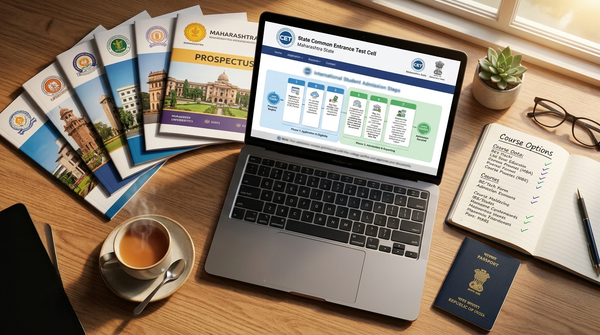
Layla found Government Law College by searching fn.mahacet.org , the Government of Maharashtra's official Foreign Candidate Registration Portal, operated by the State Common Entrance Test Cell, Government of Maharashtra. The portal covers programs across 6,000+ institutions in Maharashtra, including law programs. She searched for L.L.B., read through the available institutions, and chose Government Law College based on what she found.
She applied directly through the portal. No agent was involved. Her academic qualifications met the requirement. No entrance exam was required for international students. Her offer letter came through fn.mahacet.org and she arrived in Mumbai for the new semester.
Her Message to Afghan Women Considering Law
Layla's message is for any Afghan woman who has considered law but not yet made the decision. Law is the subject that sits underneath everything else in a society. Engineering builds the infrastructure. Medicine treats the people. Law defines the framework within which all of it happens, and determines what protections people have when things go wrong.
Understanding law is understanding how power is organised, limited, and held to account. For Afghan women, that understanding is not merely professional. It is practical and immediate. Government Law College, Mumbai, is listed on fn.mahacet.org. The course is L.L.B. (5 Yrs.) under Bachelors. The application is direct. fn.mahacet.org.
Frequently Asked Questions
Find Your Program in Maharashtra
Maharashtra is India's most connected state for international students. 6,000+ institutions. Every confirmed program. One government-backed portal. No agents. No middlemen.
Apply at fn.mahacet.orgQuestions? Email student@mahacet.org or call +91-9152252049 (10am-6pm IST)
Related reading:
Khalid from Logar , L.L.B. at Government Law College, Mumbai
Soraya from Parwan , B.Ed.-M.Ed. at Shivaji University, Kolhapur
Javid from Faryab , CSE at Walchand College of Engineering, Sangli
Information sourced from fn.mahacet.org, the official Government of Maharashtra Foreign Candidate Registration Portal. MHT-CET exemption confirmed per MHT-CET 2026 Information Brochure, Section 4, Point 4.