Masood from Baghlan Studies Civil Engineering at an Institute Named After the Woman Who Raised a King.

Masood from Baghlan Studies Civil Engineering at an Institute Named After the Woman Who Raised a King.
Veermata Jijabai Technological Institute (VJTI), Matunga, Mumbai, established 1887. Civil Engineering. Found on fn.mahacet.org. Applied directly. This is Masood's story.
Masood is from Baghlan province in northern Afghanistan. He studies Civil Engineering at Veermata Jijabai Technological Institute , VJTI , in Matunga, Mumbai.
The first thing he tells you about his institute is who it is named after. Veermata Jijabai was the mother of Chhatrapati Shivaji Maharaj, the founder of the Maratha Empire. She raised him, educated him, shaped him. The institute in Matunga carries her name. Masood studies engineering in a building that has carried it since 1887.
Veermata Jijabai Technological Institute (VJTI), Matunga, Mumbai
Established 1887. One of India's oldest engineering institutions. Named after Veermata Jijabai, mother of Chhatrapati Shivaji Maharaj. 137 years of engineers graduating from this campus before Masood arrived. Now accessible to international students through fn.mahacet.org.
Veermata Jijabai and the Name on the Building
Veermata Jijabai (approximately 1598 to 1674) was the mother of Chhatrapati Shivaji Maharaj, the founder of the Maratha Empire in western India. "Veermata" means brave mother in Marathi. She is remembered as a woman of exceptional strength and determination who played a defining role in shaping her son's character, values, and ambitions.
The institute was established in 1887 as the Victoria Jubilee Technical Institute under British colonial administration. After India's independence, it was renamed Veermata Jijabai Technological Institute in her honour. VJTI is one of India's oldest engineering institutions , 137 years of engineers graduating from its Matunga campus before Masood arrived. The name is not administrative detail. It is a statement about the kind of people this institution is meant to produce.
What Civil Engineering at VJTI Involves
Civil Engineering at VJTI covers the full range of disciplines that building and maintaining physical infrastructure requires: structural analysis and design, geotechnical engineering, transportation engineering and planning, hydraulics and water resources, environmental engineering, surveying, and construction management.
Students learn how infrastructure is conceived, designed, and built to last. The structural calculations behind a bridge. The soil mechanics behind a foundation. The hydraulic design behind a drainage system. The project management behind a construction schedule. Civil engineering at this level is not approximate , it is precise, because what civil engineers build is what people's lives depend on.
The campus is in Matunga, one of Mumbai's central suburbs, connected by the Western and Central Railway lines, close to Dadar, accessible from every part of the city. Masood describes the campus as an established, serious academic environment , the kind of place where the subject is treated with the weight it deserves.
Mumbai as a Civil Engineering Environment
Mumbai is one of the world's most complex urban infrastructure environments. A coastal city of 20 million people built on reclaimed land, crossed by rail networks handling millions of passengers daily, threaded with elevated roads, undergoing ongoing metro expansion, managing the drainage challenges of a monsoon climate, and continuously growing in density. For a civil engineer, Mumbai is a live case study in every specialisation simultaneously.
Masood studies the engineering of physical infrastructure and is surrounded by it every day. The metro line under construction near the campus. The sea link visible from the shoreline. The bridges and flyovers carrying traffic across the city. The drainage systems handling monsoon rainfall. Every one of these is something a civil engineer understands at a technical level. In Mumbai, that understanding is not abstract. It is immediate and visible.
Why Civil Engineering Matters for Afghanistan
Afghanistan's infrastructure needs are among the most significant in the region. Roads connecting rural communities to cities and markets. Bridges over rivers that flood seasonally. Irrigation systems supporting agriculture in a country where farming sustains a large proportion of the population. Buildings designed to withstand seismic activity in a country that sits on active fault lines. Water supply and sanitation systems for cities and towns that are growing.
All of this requires civil engineers trained to the level that real infrastructure demands. Engineers who understand structural analysis, geotechnical conditions, hydraulics, and construction management not in theory alone but in practice. Masood is building that technical foundation at VJTI. The 137-year-old building he studies in is itself evidence that good engineering endures.
How He Found VJTI on fn.mahacet.org
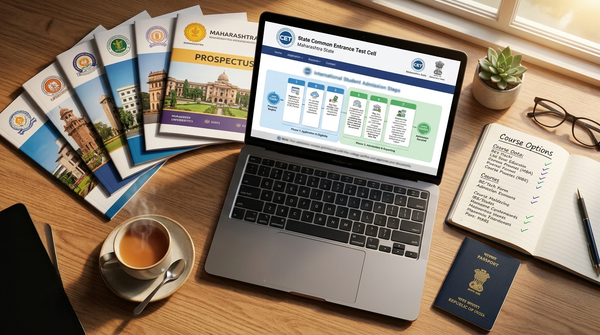
Masood found VJTI by searching fn.mahacet.org , the Government of Maharashtra's official Foreign Candidate Registration Portal. He searched for Civil Engineering under Bachelor of Engineering/Technology. VJTI appeared in the results. He read the institute details, chose it, and applied directly through the portal. No agent was involved. His 12th marks in Physics and Mathematics with one additional science subject were the academic requirement. No entrance exam was required. His offer letter came through the portal and he arrived in Matunga for the new semester.
VJTI vs Other Maharashtra Civil Engineering Institutions
| Institution | Location | Est. | City Character |
|---|---|---|---|
| VJTI (Veermata Jijabai Technological Institute) | Matunga, Mumbai | 1887 | Coastal megacity, massive urban infrastructure |
| COEP (College of Engineering Pune) | Shivajinagar, Pune | 1854 | Fast-growing technology and industrial city |
| YCCE (Yeshwantrao Chavan College of Engineering) | Nagpur | 1984 | Central India, planned development hub |
All three are available through fn.mahacet.org. For civil engineering, the choice of city matters , the infrastructure challenges of Mumbai, Pune, and Nagpur are genuinely different. All three are valid paths. VJTI offers the deepest institutional history and the most complex urban infrastructure context.
Frequently Asked Questions
Find Your Program in Maharashtra
Maharashtra is India's most connected state for international students. 6,000+ institutions. Every confirmed program. One government-backed portal. No agents. No middlemen.
Apply at fn.mahacet.orgQuestions? Email student@mahacet.org or call +91-9152252049 (10am-6pm IST)
Related reading:
Mursal from Mazar-i-Sharif , Civil Engineering at COEP Pune
Samir from Takhar , Civil Engineering at YCCE Nagpur
Javid from Faryab , CSE at Walchand College of Engineering, Sangli
Information sourced from fn.mahacet.org. MHT-CET exemption confirmed per MHT-CET 2026 Information Brochure, Section 4, Point 4.