Zainab from Balkh Chose Automobile Engineering at Pillai College, New Panvel. Someone Has to Design the Vehicles That Rebuild Afghanistan.

Zainab is from Balkh province in northern Afghanistan. She studies Automobile Engineering at Mahatma Education Society's Pillai College of Engineering in New Panvel, near Mumbai, Maharashtra.
The question she gets asked most is always a version of the same thing. Why Automobile Engineering? Why would an Afghan woman choose that?
Her answer is always the same. Someone has to design the vehicles that rebuild Afghanistan. The trucks that carry construction materials. The buses that connect rural communities to schools and hospitals. The ambulances. The agricultural equipment. The transport infrastructure that a country rebuilding itself depends on, machine by machine, vehicle by vehicle. Someone has to understand how those systems are engineered. Someone has to be able to design them, improve them, and eventually build local capacity to produce them.
Why not her?
She found Pillai College of Engineering on fn.mahacet.org. She applied directly. No entrance exam was required.
What Automobile Engineering Is
Automobile Engineering covers the design, development, manufacture, and maintenance of vehicles and their systems. It applies principles from mechanical engineering, electrical engineering, and materials science to the specific challenges of creating vehicles that are safe, efficient, durable, and purpose-built for their operating environment.
The curriculum at Pillai College of Engineering covers automotive engine design and technology, vehicle dynamics and handling, transmission and drivetrain systems, automotive materials and manufacturing processes, vehicle body design and aerodynamics, fuel systems and energy management, automotive electronics and embedded systems, and vehicle testing and quality assurance. Graduates understand the vehicle as an integrated engineering system : how every component interacts with every other, and how design decisions affect the performance of the whole.
Automobile Engineering is evolving rapidly. The global shift from internal combustion engines toward electric and hybrid drivetrains, the integration of computing and sensors into vehicles, the development of safety and automation systems : all of these are active areas of development reshaping the automotive industry worldwide. Students studying Automobile Engineering now are training for an industry in significant transition. The skills they are building : energy systems understanding, vehicle dynamics, embedded electronics : are directly applicable to the next generation of vehicles.
For Afghanistan, where much of the existing vehicle fleet is aging and where transport infrastructure is a rebuilding priority, engineers who understand how vehicles work at a deep technical level are a practical necessity, not a distant aspiration. Zainab is training to be one of those engineers.
Pillai College of Engineering, New Panvel
Mahatma Education Society's Pillai College of Engineering is located in New Panvel, which is part of the Navi Mumbai metropolitan area in Raigad district, Maharashtra. New Panvel is a planned city area forming part of the extensive development of Navi Mumbai : the satellite city built across the Thane Creek from Mumbai.
The college is affiliated with the University of Mumbai and offers engineering programs across multiple disciplines. The Automobile Engineering laboratories at Pillai College include automotive systems testing equipment, engine analysis facilities, vehicle simulation setups, and manufacturing process facilities appropriate to the curriculum's demands.
New Panvel's location is directly relevant to an Automobile Engineering student. Pune, which hosts the headquarters and manufacturing plants of major Indian and international automotive companies, is approximately 150 kilometres away. The Navi Mumbai-New Panvel area sits within a significant industrial zone. The component manufacturers, design centres, and automotive service sector present in the region provide context that makes the curriculum feel immediately connected to professional practice.
The Automotive Industry in Maharashtra
Maharashtra is one of India's most significant states for the automotive sector. Pune is often described as India's automotive capital, hosting Tata Motors, Bajaj Auto, Force Motors, and the India operations of Volkswagen, Mercedes-Benz, and other international manufacturers. The Chakan industrial area near Pune is one of India's most active automotive manufacturing zones.
Mumbai's port and logistics infrastructure connect Maharashtra's automotive output to global markets. The component manufacturing ecosystem : suppliers producing engine parts, electrical systems, chassis components, and body panels : is distributed across Maharashtra's industrial zones. For an Automobile Engineering student at Pillai College in New Panvel, this industry is not something she reads about in textbooks alone. It is the operating environment she is physically close to and will enter professionally on graduation.
Why an Afghan Woman Chose Automobile Engineering
Zainab's answer to the question she always gets is not theoretical. It is grounded in what she observes about Afghanistan's practical needs and the gap between those needs and the available engineering capacity.
Afghanistan's transport infrastructure has been significantly affected by decades of conflict and underdevelopment. Road networks are being rebuilt. The vehicle fleet is aging : a large proportion of the trucks, buses, and agricultural vehicles operating across the country are old, technically outdated, and maintained by people without formal engineering training. As the country rebuilds, the demand for engineers who understand vehicle design, specification, and maintenance at a professional level will grow.
The country will need people who can specify vehicles appropriate for Afghan road conditions and use cases, supervise maintenance operations at a technical level, participate in fleet procurement decisions, and work toward eventual local manufacturing capacity. These are not distant future requirements. They are present requirements with a growing skills gap.
Zainab is training to fill part of that gap. She is doing it in one of India's most active automotive engineering education environments, at an institution close to the country's automotive industrial heartland. Her decision to choose Automobile Engineering is not unconventional when viewed through the lens of what Afghanistan actually needs. It is a direct response to a real requirement.
How She Found fn.mahacet.org and Applied
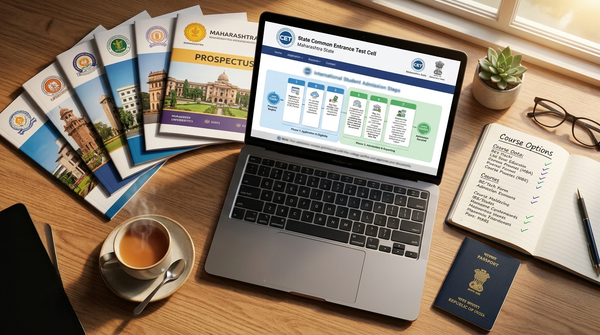
Zainab found Automobile Engineering at Pillai College of Engineering by searching fn.mahacet.org : the Government of Maharashtra's official Foreign Candidate Registration Portal, operated by the State Common Entrance Test Cell, Government of Maharashtra.
She used the search filters. She selected Bachelors under Applying For. She selected Bachelor of Engineering/Technology under Course Name. She selected Automobile Engineering under Specialization. Mahatma Education Society's Pillai College of Engineering appeared in the available programmes results. She read the institute details and applied directly through the portal. No agent was involved at any stage.
The Application Process
Zainab confirmed her eligibility using the free category checker at fn.mahacet.org/category-check. As an Afghan national, her category is Foreign National Student. She selected the Automobile Engineering program at Pillai College from the portal's results.
The academic requirement for Automobile Engineering under Bachelor of Engineering/Technology through fn.mahacet.org is a passed 12th grade examination with Physics and Mathematics as compulsory subjects, plus one additional relevant science subject, with a minimum aggregate of 45 percent combined. Zainab had Physics, Mathematics, and Chemistry in her 12th grade from Balkh. Her results met the requirement.
She uploaded the required documents: passport, 12th grade academic certificates, and a passport-size photograph. She paid the eligibility fee of USD 50 through the CCAvenue payment gateway on the portal. Foreign currency is accepted. After her documents were verified, she paid the processing fee of USD 1,150. Both fees are fixed, government-regulated, and listed on fn.mahacet.org before any payment is made. They are non-refundable.
No entrance exam was required. International students applying for Automobile Engineering through fn.mahacet.org are not required to sit MHT-CET. Her offer letter arrived through the portal. She completed FRRO registration within 14 days of arriving in India. Physical document verification took place at Pillai College.
Her Message
Zainab's message to Afghan students : especially Afghan women : is direct and unhurried. Choose the subject you need. Not the subject that seems safe. Not the subject that people expect from you based on your gender. The subject that matches what you understand Afghanistan needs and what you have the ability to learn.
Automobile Engineering is listed on fn.mahacet.org. The search filters will show it. Pillai College of Engineering in New Panvel is one institution offering it. The academic requirement is 12th grade Physics and Mathematics with a relevant additional subject and 45 percent aggregate. The fees are USD 50 and USD 1,150, fixed and listed before payment. The application is direct.
Someone has to design the vehicles that rebuild Afghanistan. Afghan women build too. fn.mahacet.org.
Frequently Asked Questions
Does Automobile Engineering at Pillai College require an entrance exam for international students?
No. Automobile Engineering under Bachelor of Engineering/Technology through fn.mahacet.org requires no entrance exam for international students. Admission is based on 12th grade marks in Physics and Mathematics with one additional science subject and a minimum aggregate of 45 percent. Portal fees are USD 50 eligibility and USD 1,150 processing, both fixed and listed before payment. Apply directly through fn.mahacet.org.
How is Automobile Engineering different from Mechanical Engineering on fn.mahacet.org?
Automobile Engineering is specifically focused on vehicle systems : engines, drivetrains, vehicle dynamics, automotive electronics, and vehicle manufacturing. The entire curriculum is oriented toward the automotive industry. Mechanical Engineering is a broader discipline covering machines, energy systems, manufacturing, and thermodynamics across all sectors, with less vehicle-specific depth. For students who know they want to work in the automotive sector specifically, Automobile Engineering provides a more directly focused preparation. Both are available through fn.mahacet.org as Bachelor of Engineering/Technology programs.
Ready to apply?
Maharashtra is India's most connected state for international students. 6,000+ institutions. Every confirmed program. One government-backed portal. No agents. No middlemen.
Apply now at fn.mahacet.org/ : the official Government of Maharashtra portal.
Follow us: