6 Industries Where Maharashtra Graduates Dominate Globally (And Why Bahraini Students Should Pay Attention)
Ziad is from Riffa, Bahrain. He is an MBA student at a top Mumbai business school. And before he applied, he did something that most prospective international students forget to do: he researched where the graduates actually go.
Not which university has the best campus. Not which city has the most interesting food scene. Where do the graduates work? Which industries do they enter? Which countries do they end up in? What is the actual return on the years and the money?
What Ziad found was not what he expected. Maharashtra's graduates - across engineering, medicine, management, pharmacy, hospitality, and technology - are not just working in India. They are working in Dubai, Singapore, London, New York, and across the Gulf. They are leading teams at global corporations. They are heading departments at international hospitals. They are running logistics operations for infrastructure projects that are reshaping the GCC.
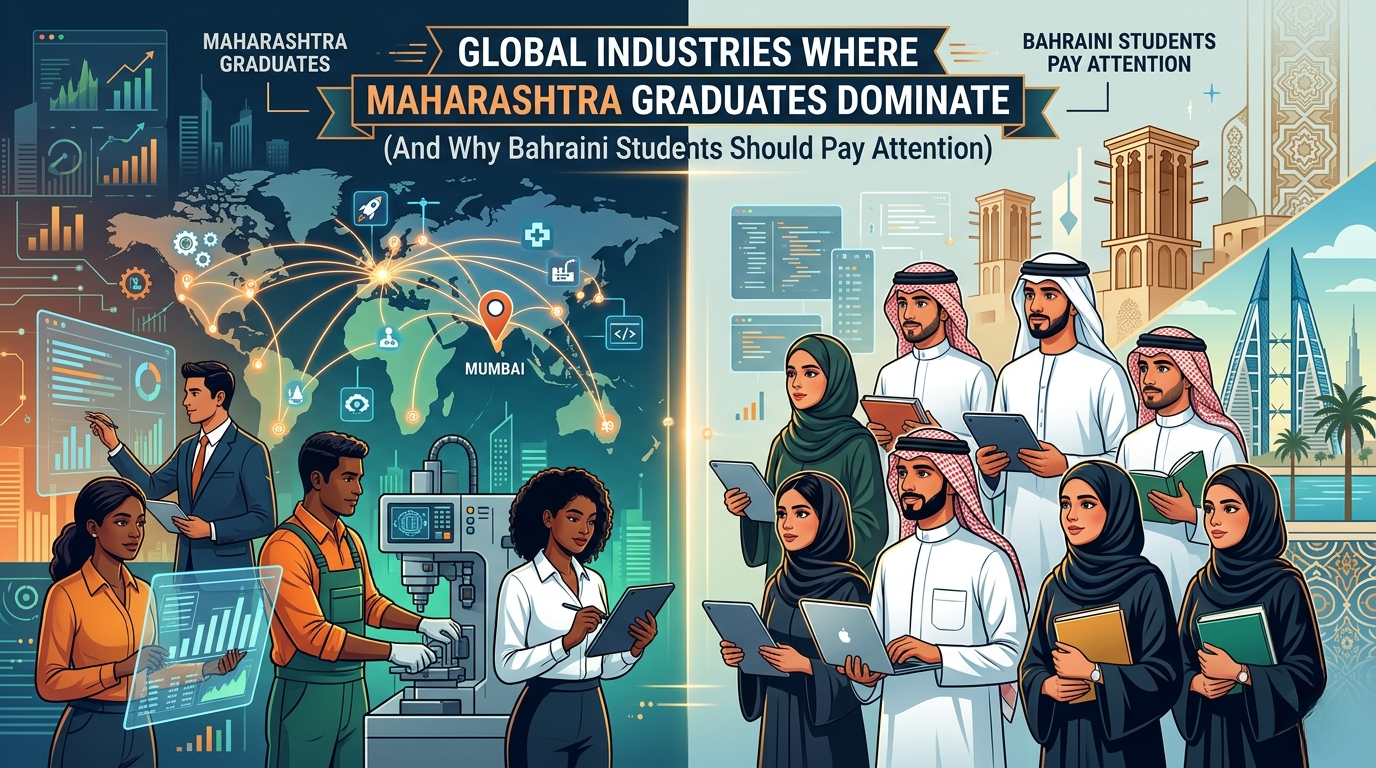
Here are the 6 industries where Maharashtra graduates dominate globally - and why Bahraini students specifically should be paying close attention.
Industry 1: Technology - From IIT Bombay to Google, Microsoft, and Beyond
India produces more software engineers than any other country in the world. Maharashtra produces more of them than any other Indian state. The ecosystem is anchored by IIT Bombay - consistently ranked in the global top 150 for engineering and technology - whose graduates are recruited by Google, Microsoft, Meta, Amazon, and every major technology company operating at global scale.
The pipeline runs directly. IIT Bombay runs global recruiting seasons. Major tech companies send representatives to Pune's Hinjewadi IT Park - one of Asia's largest technology business parks - to recruit from TCS, Infosys, Wipro, Cognizant, and the hundreds of mid-size technology companies that orbit the Maharashtra tech ecosystem.
For a Bahraini student studying Computer Science, MCA, or engineering in Maharashtra, the network that surrounds their degree is not theoretical. It is a functioning global recruitment system that places graduates in technology roles across the Gulf, Southeast Asia, Europe, and North America.
BE/B.Tech and MCA programs are listed under Technical Education on fn.mahacet.org - the Government of Maharashtra's official portal for international students. Government-regulated fees. NAAC-accredited institutions. No agent required.
Industry 2: Finance and Banking - Mumbai to Dubai, Singapore, and London
Mumbai is the financial capital of the world's fifth largest economy. The Reserve Bank of India, the Bombay Stock Exchange - the oldest stock exchange in Asia - and the India headquarters of every major global bank, private equity firm, and investment management company are all located within the city where Maharashtra's MBA students study.
The career pathway from a Maharashtra business school to a Gulf banking role is well-established and actively used. Bahrain's financial sector - the GCC's banking hub - recruits management professionals from Indian business schools with consistent frequency. Dubai's banking and finance ecosystem places particular value on MBA graduates who have built networks in Mumbai's financial ecosystem.
Singapore's role as a regional headquarters for multinational corporations in Asia creates consistent demand for MBA graduates with strong analytical training and Asian market familiarity. Maharashtra's top business school alumni are present in Singapore's financial services sector in significant numbers.
MBA and MMS programs are listed under Higher Education on fn.mahacet.org. Government fees. Direct application. No agent.
Industry 3: Pharmaceuticals - Mumbai to the World's Largest Drug Companies
Mumbai is the global headquarters of Sun Pharma, Cipla, and Dr Reddy's - three of the world's largest producers of generic pharmaceuticals. The city's pharmaceutical ecosystem is the most active in Asia. India supplies over 50% of the world's vaccines and approximately 40% of all generic medicines consumed in the United States. Maharashtra produces a significant share of that output.
Pharmacy graduates - B.Pharm and Pharm D - from Maharashtra's 200+ pharmacy colleges graduate into a sector that is genuinely global in its reach. The Gulf pharmaceutical distribution market, Middle East hospital pharmacy systems, and international regulatory affairs roles at major pharma companies all actively recruit Maharashtra-trained pharmacists and pharmaceutical scientists.
For Bahraini students who understand that Bahrain imports the majority of its essential medicines and that the Gulf pharmaceutical market is growing rapidly, a pharmacy degree from Maharashtra is not just an individual career asset. It is a credential with direct regional relevance.
B.Pharm and Pharm D are listed under Technical Education on fn.mahacet.org. Government-regulated fees. 200+ colleges.
Industry 4: Infrastructure and Engineering - Gulf Construction and Beyond
The GCC's infrastructure development pipeline is one of the most active in the world - Vision 2030 in Saudi Arabia, Bahrain's urban development expansion, UAE mega-projects, Qatar's continued post-World Cup development. All of these require civil engineers, structural engineers, and infrastructure management professionals trained to international standard.
Maharashtra's 500+ engineering colleges produce civil engineers, structural engineers, mechanical engineers, and geotechnical specialists at scale. The state's infrastructure context - a rapidly urbanising state with complex challenges in roads, bridges, water systems, and urban transit - means that engineering students are exposed to real-world infrastructure challenges from their earliest years.
Nashik's industrial manufacturing sector, Pune's automotive engineering ecosystem, and Mumbai's megacity infrastructure provide a breadth of practical exposure that prepares Maharashtra engineering graduates for the Gulf's demanding project environments. The track record of Maharashtra engineering graduates working in Gulf construction and infrastructure is long-established.
BE/B.Tech engineering is listed under Technical Education on fn.mahacet.org with over 500 colleges across Maharashtra.
Industry 5: Healthcare - NMC-Recognised MBBS Opens Global Doors
The National Medical Commission recognition that underlies every government MBBS program listed on fn.mahacet.org is not a bureaucratic detail. It is the key that opens the international healthcare career pathway.
NMC recognition is accepted by the Gulf Health Council - the body that governs medical licensing across the GCC - as a valid foundation for licensing applications in Bahrain, UAE, Saudi Arabia, Kuwait, and Qatar. Maharashtra's 30+ government medical colleges, each affiliated with major teaching hospitals and producing MBBS graduates with real clinical exposure from the first year, provide a career foundation that is directly applicable to Gulf healthcare employment.
KEM Hospital, Nair Hospital, and the network of Maharashtra government teaching hospitals process patient volumes that match or exceed the caseloads of the world's leading teaching hospitals. An MBBS graduate who has trained in these environments is prepared for the clinical demands of Gulf hospital employment in a way that graduates from lower-exposure programs are not.
MBBS programs are listed under Medical Education on fn.mahacet.org. 30+ NMC-recognised government medical colleges. Government-regulated fees. Direct application.
Industry 6: Hospitality - Maharashtra Hotel Management to International Chains
Maharashtra's hotel management graduates - from B.HMCT programs at accredited Aurangabad, Mumbai, and Pune institutions - are recruited by Taj, Oberoi, Marriott, Hilton, IHG, and every major international hotel chain with operations across the Gulf and Southeast Asia.
Bahrain's hospitality and tourism sector is growing. The kingdom's ambitions as a regional leisure, business, and heritage destination require hospitality professionals trained to the standards that international hotel chains apply globally. Maharashtra's B.HMCT programs - taught in the same cities that host international heritage tourists visiting Ajanta and Ellora Caves, the Taj Mahal Hotel, and Maharashtra's wine country - produce graduates who understand the operational demands of international hospitality from practical training environments.
The career pathway from a Maharashtra B.HMCT to a Gulf hotel management role is active and well-trodden. For a Bahraini student considering the hospitality sector, a B.HMCT from Maharashtra is a credential that opens specific doors in the Gulf market.
B.HMCT is listed under Technical Education on fn.mahacet.org. Government fees. NAAC-accredited institutions.
Frequently Asked Questions
Are Maharashtra degrees recognised by employers in Bahrain specifically?
Yes, across the key disciplines. MBBS from NMC-recognised Maharashtra government medical colleges is accepted by the Gulf Health Council as a foundation for Bahraini medical licensing. Engineering degrees from NAAC-accredited Maharashtra institutions are recognised by Gulf engineering employers and professional bodies. MBA and MMS from Maharashtra's top business schools have an established track record of placement in Bahrain and across the GCC in banking, finance, and corporate management. Pharmacy degrees from Maharashtra are recognised by Gulf pharmaceutical employers. Bahraini students are advised to verify the current recognition status of their specific institution with the relevant Bahraini professional licensing authority for their field before enrolling - all institution details and accreditation information are listed on fn.mahacet.org per college.
Related Reading from Study in Maharashtra
- Bahrain and India: 5,000 Years of Connection - Why Maharashtra Is the Natural Choice
- Stop Paying Education Agents: The Only Website International Students Need
- MBA in Mumbai for Bahraini Students: Building Careers in India's Financial Capital
Maharashtra is India's most connected state for international students. Over 3,000 colleges. Every discipline. One government-backed portal. No agents. No middlemen.
Apply now at fn.mahacet.org - the official Government of Maharashtra portal.
Follow us:
- Instagram: @admissiondeskedu
- YouTube: Edulab Educational Exchange
- Facebook: @admissiondeskedu