COEP Pune for Sri Lankan Students: Why a 172-Year-Old Engineering University Changed My Family's Mind

COEP Pune for Sri Lankan Students: Why a 172-Year-Old Engineering University Changed My Family's Mind
Why a 170-year-old engineering university matters for your family's biggest decision in 2026
When I told my parents I wanted to study engineering in Pune, the first thing my father did was open his laptop and Google COEP. For a Sri Lankan parent in 2026, that simple search is often the moment a decision is made. Mine was no different. The page that came up said the college was founded in 1854. My father looked at me and said one sentence in Sinhala that I will never forget: "This university is older than our country is free." That was the moment the conversation changed. If you are a Sri Lankan student considering COEP Pune for your undergraduate engineering degree, this is the guide I wish I had when I was standing in my family's living room trying to explain my choice.
What COEP Actually Is, in Simple Terms
COEP stands for the College of Engineering Pune, officially called COEP Technological University since June 2022, when the Government of Maharashtra elevated it to the status of a Unitary Public Technological University. It is not a private college. It is not a commission-driven institution. It is a state-run university, which is the single most important fact for any Sri Lankan family worried about recognition and legitimacy.
The campus is in Shivajinagar, Pune, a city known across India as the "Oxford of the East." The university offers 12 undergraduate engineering programmes, 25 postgraduate programmes, and doctoral research across mechanical, computer, electronics, civil, electrical, and newer specialisations like robotics and artificial intelligence. Total student population sits at around 5,000, with 863 BTech seats available each year across all programmes.
What makes COEP unusual is its age. Established in July 1854 as the Poona Engineering Class and Mechanical School, it is the third oldest engineering institution in Asia, after the College of Engineering Guindy in Chennai and IIT Roorkee. In a part of the world where most good engineering universities were built in the 1960s and 1970s, COEP has been training engineers for over 170 years. For Sri Lankan parents who value institutional legacy as a measure of seriousness, this single number does more persuasion than any marketing brochure ever could. The official foreign student registration portal is fn.mahacet.org, where CIWGC, NRI, OCI, PIO, and foreign national candidates apply directly without needing an agent.
Why the 1854 Number Matters So Much to Sri Lankan Parents
There is a specific psychology in Sri Lankan households when it comes to education decisions abroad. Parents are not looking for "amazing." They are looking for safe. They are looking for a track record long enough that the decision feels boring, in the best possible sense. Sri Lanka gained independence from Britain on February 4, 1948. COEP was founded 94 years before that. When my father did that math out loud, the anxiety in the room dropped by half. An institution that has survived the British Raj, two World Wars, Indian independence, multiple economic cycles, and is now a state-chartered technological university is not going to disappear while your child is enrolled. That is the argument that lands.
There is also a second, quieter argument. In the Sri Lankan job market, degree recognition is everything. Employers and government bodies look at where the degree is from more than what the specialisation is. A degree from COEP Technological University, Maharashtra, is a degree from a state-run Indian public university. It is recognised by the University Grants Commission of Sri Lanka for equivalence verification, the same way degrees from other established Indian public universities are. My uncle, who works in a Colombo engineering firm, told me honestly: "If you bring a COEP degree home, nobody is going to question it. They will just ask when you can start."
Admission for Sri Lankan Students, The Actual Process
This is the part most agents will complicate on purpose. The real process is simple and I will walk you through exactly how it works.
COEP admits 80 percent of its BTech seats through the MHT CET (Maharashtra Health and Technical Common Entrance Test), which is the state-level entrance exam. The remaining 20 percent of seats are filled through JEE Main scores on an All India basis. For Sri Lankan students, there is a separate supernumerary quota that sits over and above these sanctioned seats. This is the CIWGC, NRI, PIO, OCI, and Foreign National quota, and it is designed specifically for international applicants like you.
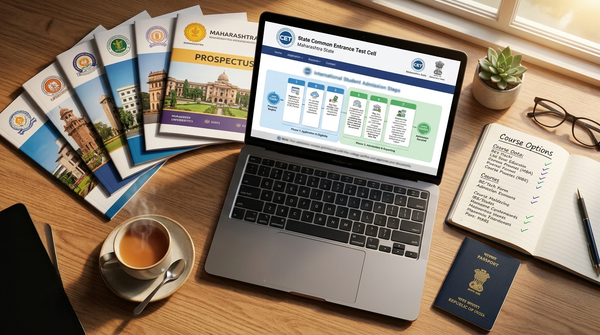
The application portal for all foreign-quota seats across Maharashtra's engineering, pharmacy, architecture, and other professional courses is fn.mahacet.org. This is run directly by the State Common Entrance Test Cell, Government of Maharashtra. There are no agents involved. There is no commission. The website allows you to register, upload your A/L results, verify your eligibility, and participate in the Centralised Admission Process (CAP). The CAP rounds typically run in July and August, which means Sri Lankan students who finalise their applications by May have comfortable time to prepare documents and plan travel. COEP Technological University does not accept any direct applications outside of this centralised process for foreign-quota seats, which is another quiet protection against scams.
What It Costs and Why Sri Lankan Families Can Afford It
I will be honest about the cost, because that is the part Sri Lankan families need most. Foreign-quota tuition fees at Maharashtra state universities are higher than the regular Maharashtra-domicile rate, but they are still significantly lower than comparable private engineering colleges in India or any English-language engineering programme in the UK, Australia, or Canada. For the exact current fee structure for your course, you must check the official COEP Technological University website and the fn.mahacet.org foreign-candidate section, as fees are revised annually and I refuse to put a number in a blog that might be out of date by the time you read it.
What I can tell you is this. When you add up tuition plus hostel accommodation plus monthly living costs in Pune, the total annual cost for a Sri Lankan student at COEP comfortably fits within what a middle-income Sri Lankan family can manage, especially compared to the alternative of an unrecognised private college in Europe for three times the price. Pune is also one of the more affordable major Indian cities for students, with shared hostel rooms, affordable daily meals, and public transport that does not require a car.
What Sri Lankan Students Should Know Before Saying Yes
I want to be honest about one real challenge. COEP is not easy. The entrance bar through the foreign quota is lower than the MHT CET cutoff for Maharashtra-domicile students, but once you are in, the academic rigour is the same. The average JEE Main percentile for a computer engineering seat here sits above 98. Your classmates will be some of the sharpest students in western India. If you are looking for an easy degree, this is not it. If you are looking for a degree that will actually teach you engineering, and stamp your resume with an institution that has been producing engineers for 172 years, this is exactly it.
The second honest thing is the language adjustment. Pune is a Marathi and Hindi-speaking city. Classes at COEP are in English, so academics are not a problem. Daily life outside campus, ordering food, catching a rickshaw, will require you to pick up functional Hindi within your first two months. It is manageable. Most Sri Lankan students settle in within one semester.
Frequently Asked Questions
Q: Will my COEP degree be recognised in Sri Lanka for jobs and further studies?
A: Yes. COEP Technological University is a state-chartered public university of the Government of Maharashtra, and degrees from recognised Indian public universities are generally accepted by the University Grants Commission of Sri Lanka for equivalence. You should verify the current equivalence procedure directly with the UGC Sri Lanka before enrolling, but the base recognition is in place.
Q: Do I need to take the MHT CET or JEE Main as a Sri Lankan student?
A: Not necessarily. The foreign-quota supernumerary seats for CIWGC, NRI, PIO, OCI, and Foreign National candidates have their own eligibility pathway through fn.mahacet.org. You should check the current-year eligibility criteria on the portal, as the rules are updated each admission cycle. Do not rely on agents for this information, go directly to the source.
Closing
If you are reading this as a Sri Lankan student still waiting for your A/L re-scrutiny result (the re-correction window closes April 22, 2026, so do not miss it), or as a parent trying to decide if COEP is the right call for your child, my only honest advice is this. Do what my father did. Open your laptop. Type COEP. Read the first paragraph that tells you 1854. Let that number do its quiet work. And when you are ready to take the next step, the foreign student admission process for COEP runs through fn.mahacet.org, which is the official portal and the only one you should trust.
My parents took three evenings of conversation to say yes. The 1854 fact was on the table by evening one. The rest was just logistics.