Everyone Thinks Maharashtra Means Only Engineering. That Belief Might Cost You the Right Future.
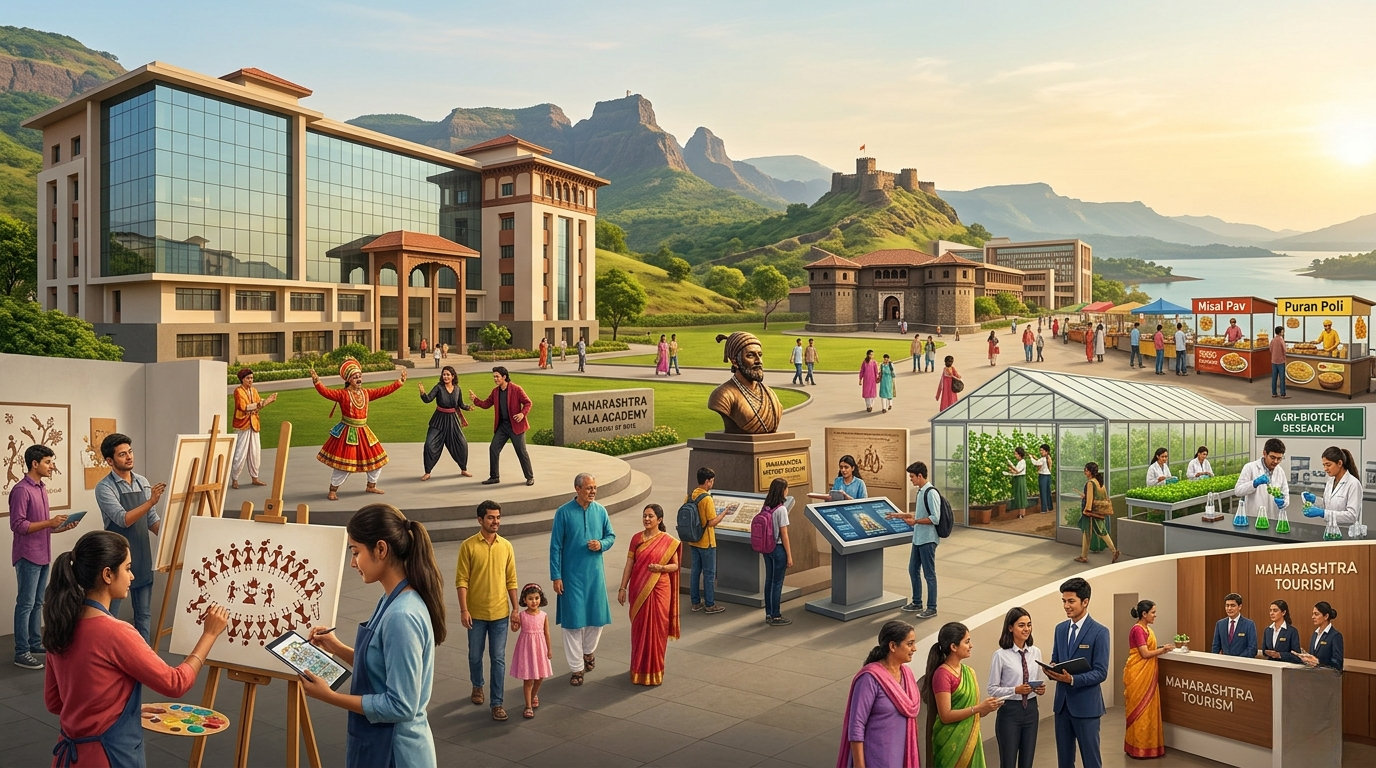
The state that shaped India's industrial backbone now offers international students something far broader — if they know where to look.
There is a version of this conversation that happens every year, in living rooms and WhatsApp groups across Thailand, Nepal, the Gulf, and beyond. A student announces they want to study in Maharashtra. Someone in the room nods and says: "Engineering, right?"
It's an understandable assumption. Maharashtra's reputation in technical education is formidable — and well-deserved. But when that assumption becomes the default, it quietly closes doors that were never locked. Students end up choosing a field because their peers chose it, not because it fits where they're actually headed.
That is the mistake worth avoiding. And avoiding it starts with understanding the full scope of what Maharashtra actually offers.
Engineering Is Massive — But It's One Part of a Much Bigger Picture
Let's acknowledge what's true: engineering in Maharashtra is exceptional. Computer science, artificial intelligence, electronics, and related disciplines are offered across some of India's most respected technical institutions, and the state's proximity to Mumbai — home to India's largest technology and startup ecosystem — means that internship access, industry exposure, and placement pipelines are genuinely strong.
Through the Government of Maharashtra's official Foreign Candidate Registration Portal at fn.mahacet.org, international students can access undergraduate programmes including BE/B.Tech across specialisations, as well as postgraduate options like M.E/M.Tech. These aren't generic degrees — they're qualifications built in an environment where the industry is next door.
But the conversation shouldn't stop at engineering. Because for many students, it isn't the right fit — and choosing it because everyone else does is a path to a degree that doesn't serve the life you actually want.
MBA: Why Mumbai Changes Everything
Business education in Maharashtra occupies a different category entirely, and it's rising fast — particularly for international students who understand what real-world exposure during a degree actually means.
Mumbai is India's financial capital. Stock exchanges, multinational headquarters, banking institutions, consulting firms, media companies, and some of Asia's most active startup communities all operate within the city's boundaries. Studying for an MBA or MMS here is not the same as studying for the same qualification in an isolated campus environment. The city is the classroom extension.
The portal at fn.mahacet.org includes MBA/MMS under its postgraduate technical education stream, and international candidates — Foreign Nationals, NRIs, OCIs (PIOs), CIWGC students and Merch.Navy — can access this through the official single-window admission system. For students with entrepreneurial ambitions, finance careers, or corporate leadership goals, the Mumbai business environment is not a footnote. It is a core part of the value proposition.
Medical and Healthcare: The Underestimated Strength
This is the area where the gap between perception and reality is widest — and where international students, particularly from Thailand, most frequently discover options they didn't know existed.
Maharashtra has a robust healthcare education ecosystem. The portal covers Medical Education, Pharmacy at both undergraduate (B.Pharm / Pharm D) and postgraduate (M.Pharm / Pharm D) levels, and AYUSH — which includes Ayurveda, Yoga, Unani, Siddha, and Homeopathy. These are government-recognised, professionally structured programmes, not peripheral options. For students whose ambitions lie in healthcare, medicine, or the rapidly growing global wellness industry, Maharashtra is a serious destination — one that simply doesn't receive the same word-of-mouth attention as engineering.
The full breadth of available courses spans six education streams through the portal: Technical Education, Higher Education, Agriculture, Fine Arts, Medical, and Ayush. Across all of these, the admission pathway for international candidates runs through one address: fn.mahacet.org.
The Real Question: What Does Your Future Actually Need?
The most useful reframe for any student currently comparing options is this — don't start with the degree name. Start with the outcome.
What industry do you want to work in five years from now? What kind of city environment makes you sharper? What does your home country's job market reward when you return? What global career paths does this qualification open?
Engineering, MBA, medicine, pharmacy, fine arts, agriculture — each of these tracks leads somewhere specific. The students who choose well are the ones who examine the destination before they book the journey.
Checking Eligibility Before Comparing Colleges
One practical mistake compounds the confusion: students begin researching colleges before they've confirmed which international student category applies to them. The portal operates across five categories — Foreign Nationals, NRIs, OCIs (PIOs), CIWGC students and Merch.Navy — each with specific documentation requirements. Skipping this step wastes time and risks applying through the wrong process entirely.
fn.mahacet.org includes a built-in "Find My Student Category" tool that resolves this in minutes. Use it first. Then explore courses. Then compare institutions.
That line is worth sitting with. A degree completed in the wrong field, chosen for the wrong reasons, is four or more years pointed in a direction that doesn't serve you. A degree chosen deliberately — with clarity about the industry, the city, the career, and the qualification — compounds in value for decades.
Maharashtra offers that deliberate choice across more fields than most international students realise. The starting point is one portal, one registration, and one honest look at where you're actually headed.
Begin at fn.mahacet.org.