Festivals You'll Enjoy While Studying in Maharashtra
Festivals You'll Enjoy While Studying in Maharashtra
fn.mahacet.org lists Ganesh Chaturthi and the Kala Ghoda Arts Festival as part of what international students experience in Maharashtra. The reality is richer than that — here is the full picture of what studying here looks like across a calendar year.
When fn.mahacet.org describes why international students choose Maharashtra, it names four qualities: quality education, diverse courses, affordability, and holistic enriching experiences. That fourth one is specific — "Students participate in cultural festivals like Ganesh Chaturthi, Kala Ghoda Arts Festival, and heritage tours to Ajanta, Ellora, and Raigad Fort. These activities foster creativity, cultural awareness, and personal growth." This guide expands on exactly what that looks like, sourced from fn.mahacet.org and studyinmaharashtra.org.
From fn.mahacet.org — Cultural Diversity: "From classical dance forms like Lavani to the vibrant festivals of Ganesh Chaturthi and Gudi Padwa, Maharashtra offers endless opportunities to explore local traditions."
The Festival That Defines Maharashtra
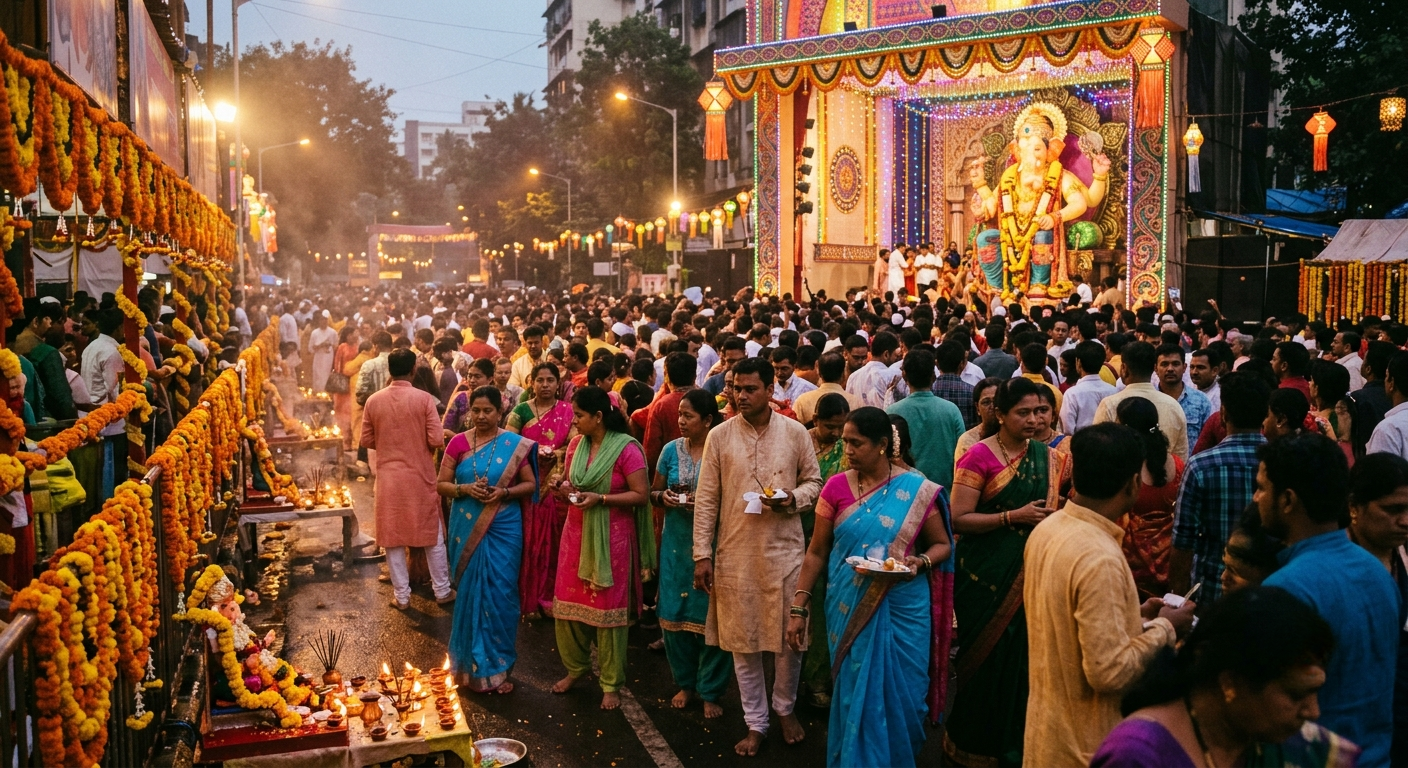
Ganesh Chaturthi is the festival that international students in Maharashtra most consistently describe as transformative — and fn.mahacet.org names it first among the cultural experiences students will encounter here. It is Maharashtra's state festival, a 10-day celebration of Lord Ganesha — the god of new beginnings, wisdom, and the remover of obstacles — observed across every city, town, and campus in the state.
For students in Mumbai, the scale is genuinely unlike anything else in India. Around 150,000 Ganesha idols are immersed in Mumbai alone at the festival's close. The city's iconic Sarvajanik (public) Ganesh Mandals — including Lalbaugcha Raja, Ganesh Galli Mandal, Andhericha Raja, and Mumbaicha Raja — draw millions of visitors across the 10 days. The chant "Ganpati Bappa Morya" echoes through streets, campuses, and dormitories. Drums, processions, community feasting, and the release of the idol into the sea on the final day (Ananta Chaturdashi) are experiences students remember for years.
In Pune, where the public celebration was initiated by freedom fighter Bal Gangadhar Tilak in 1893, Ganeshotsav carries particular historical weight. College campuses across both cities set up their own Ganesh Mandals, and international students are actively welcomed to participate. No knowledge of Marathi is needed to feel the energy of a city that stops everything for ten days every August or September.
The Full Calendar — What Else You Will Experience
fn.mahacet.org specifically names Gudi Padwa alongside Ganesh Chaturthi as one of Maharashtra's defining festivals: "the vibrant festivals of Ganesh Chaturthi and Gudi Padwa, Maharashtra offers endless opportunities to explore local traditions." Gudi Padwa marks the Marathi New Year, celebrated on the first day of the Chaitra month of the Hindu calendar, typically in late March or early April.
Students in Pune and Mumbai will see colourful processions, traditional Marathi clothing, and homes decorated with a Gudi — a decorated pole topped with a bright cloth, a garland of neem leaves, and an upturned vessel — erected outside windows and balconies. For international students, it is an accessible festival: public processions run through major areas, and campus events often mark the day with traditional food and music.
fn.mahacet.org names the Kala Ghoda Arts Festival alongside Ganesh Chaturthi as part of what students will experience: "cultural festivals like Ganesh Chaturthi, Kala Ghoda Arts Festival, and heritage tours to Ajanta, Ellora, and Raigad Fort." Kala Ghoda is Mumbai's annual nine-day arts, music, film, theatre, and dance festival, held in the Fort district of South Mumbai — home to the city's heritage precinct and several leading Mumbai University colleges.
For international students studying at institutions in South and Central Mumbai — VJTI Matunga, University of Mumbai Fort Campus, HSNC Churchgate — the festival is close to campus. It draws artists, performers, and audiences from across India and internationally, and is accessible entirely without admission fees for most outdoor events.
Diwali is a five-day festival observed across all of India, and Maharashtra's cities mark it with particular scale. For international students, Diwali typically falls in October or November — during the academic semester — meaning students experience it firsthand rather than reading about it in a brochure. Campus hostels organise Diwali events, cities glow with oil lamps and lights, and the exchange of sweets between student communities across religions and countries is genuine and common.
studyinmaharashtra.org confirms Maharashtra is home to students from 68 countries and that "cities like Mumbai and Pune are known for their cosmopolitan lifestyles" — which means Diwali in these cities is a shared experience rather than an outsider observation. Students from Bangladesh, Nigeria, Oman, Sri Lanka, and Japan all report it as one of the most memorable experiences of their time in Maharashtra.
Maharashtra has a significant Muslim population, and both Eid ul-Fitr and Eid ul-Adha are public holidays across the state. Mumbai's Mohammed Ali Road area near Crawford Market is one of the most famous Eid destinations in India — students from Muslim-majority countries including Bangladesh, Indonesia, Malaysia, Afghanistan, Gulf countries, and African nations consistently note the comfort of celebrating in a state where Eid is treated as a public occasion, not a minority event. Campus hostels typically make space for students observing Ramadan, and halal food is widely available in both Mumbai and Pune.
The Festival Year — When to Expect What
Maharashtra Festival Calendar — Academic Year Overview
Festivals named by fn.mahacet.org and studyinmaharashtra.org are marked. All dates vary annually by lunar calendar — check the year's schedule on arrival.
★ Named explicitly by fn.mahacet.org. Festivals marked without ★ are confirmed by studyinmaharashtra.org's description of Maharashtra's multicultural environment or are national public holidays applicable in Maharashtra. Exact dates vary annually by lunar calendar — verify each year's schedule on the Government of Maharashtra's official calendar.
Beyond Festivals — Heritage Experiences fn.mahacet.org Names
fn.mahacet.org lists not just festivals but heritage destinations as part of what students experience: "heritage tours to Ajanta, Ellora, and Raigad Fort." studyinmaharashtra.org confirms Aurangabad (officially Chhatrapati Sambhajinagar) as the heritage city in Maharashtra's university network — home to both Ajanta and Ellora, UNESCO World Heritage Sites.
Ajanta Caves: Buddhist rock-cut cave art, approximately 2nd century BCE to 5th century CE. Ellora Caves: 34 cave monasteries and temples across Buddhist, Hindu, and Jain traditions. Both are UNESCO World Heritage Sites, accessible from Aurangabad — where Dr. BAMU and the Government Engineering College are fn.mahacet.org participating institutions.
Frequently Asked Questions
fn.mahacet.org's campus life section confirms an "inclusive community welcoming students from 37+ countries," and studyinmaharashtra.org confirms "International Student Cells that assist with accommodation, orientation, academic support, and cultural integration." Most large campus festivals — including Ganesh Chaturthi Mandals run by college student committees — actively involve international students rather than positioning them as spectators.
Yes. Maharashtra's official public holiday calendar includes Ganesh Chaturthi, Diwali, Gudi Padwa, Eid ul-Fitr, Eid ul-Adha, Christmas, Independence Day, and Republic Day, among others. Class schedules adjust accordingly — typically announced at the start of each semester by the college academic calendar.
studyinmaharashtra.org describes Maharashtra as "India's most cosmopolitan state" with "300+ languages spoken in Mumbai." Students from 68 countries study here — including from Bangladesh, Indonesia, Gulf countries, Nigeria, and Japan. Eid, Christmas, and other festivals are public holidays in Maharashtra. The campus multicultural environment means students of all backgrounds participate in each other's celebrations as a matter of course.
All international admissions run through fn.mahacet.org — the Government of Maharashtra's official single-window portal operated by the State CET Cell. The eligibility check is free, takes two minutes, and confirms which courses you qualify for. For support: student@mahacet.org · +91-9076000348 / +91-8879082178 (Monday to Friday, 10am to 6pm IST).
Study in a State Where Every Month Has a Festival.
37+ countries. 300+ languages in Mumbai. Ganesh Chaturthi, Kala Ghoda, Gudi Padwa, Diwali, Eid, Christmas — all part of a student year in Maharashtra. The eligibility check is free.
Check Your Eligibility at fn.mahacet.orgQuestions? student@mahacet.org · +91-9076000348 / +91-8879082178 · Mon–Fri, 10am–6pm IST