Maharashtra vs Australia for Engineering: A Complete Cost and Quality Guide for Bahraini Students
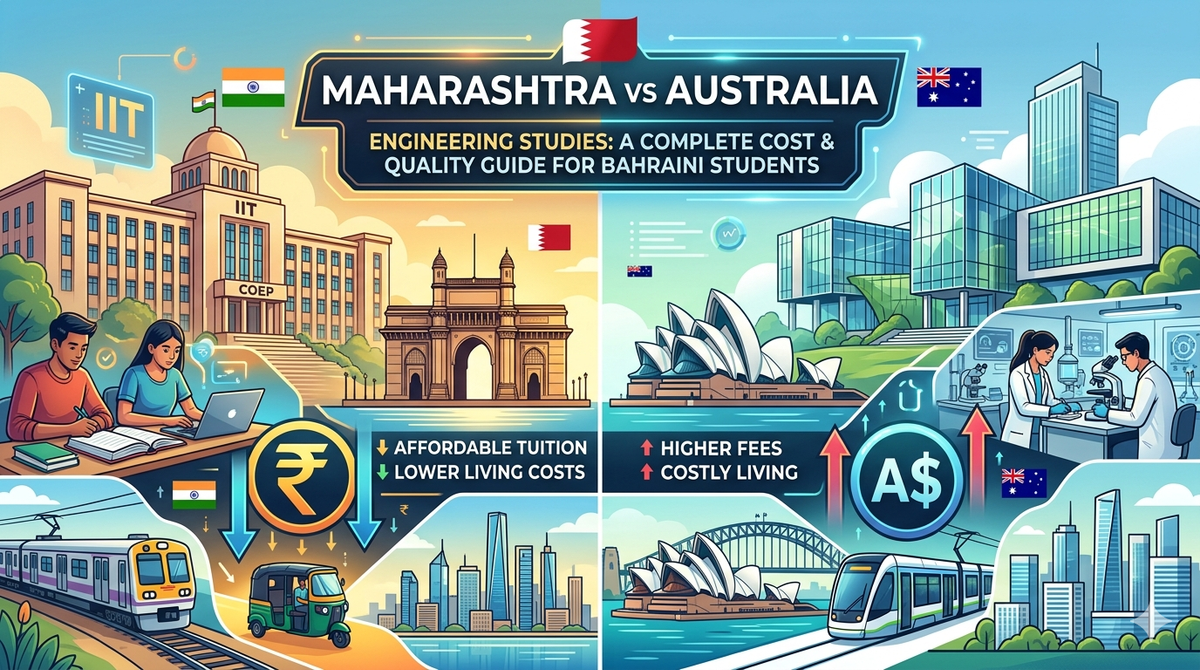
Lina opened with a number. Not a feeling, not a ranking, a number. A four-year engineering degree at a mid-tier Australian university was going to cost her family AUD 160,000 in tuition. She put that next to the government-regulated fee at a Pune engineering college and the conversation with her parents lasted about twelve minutes. The Maharashtra vs Australia engineering Bahrain students comparison rarely starts with rankings. It starts with that number.
The Cost Comparison: AUD vs Government-Regulated Maharashtra Fees
Australian universities charge international students between AUD 36,000 and AUD 50,000 per year for undergraduate engineering. Over four years, that is AUD 144,000 to AUD 200,000 in tuition before living costs in Sydney, Melbourne, or Brisbane are added. Rent in those cities for a student runs between AUD 1,200 and AUD 2,000 per month. A conservative total cost of four years in Australia lands above AUD 250,000 for most Bahraini students.
Maharashtra government-regulated engineering colleges operate under a fee structure set by the state. Annual tuition for international students at government and government-aided institutions is significantly lower, and the cost of living in Pune, which is Maharashtra's primary engineering hub, is a fraction of any Australian city.
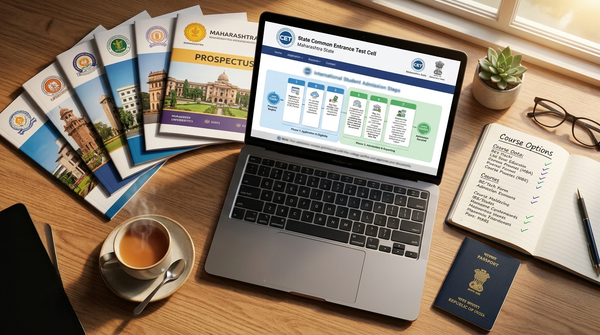
The application process for international students runs through fn.mahacet.org, the official Government of Maharashtra single-window portal. The total administrative fee through the portal is USD 1,200, split into a USD 50 eligibility fee and a USD 1,150 processing fee. That covers the full admission process with no agent required.
The cost difference between the two destinations is not marginal. For most Bahraini families, it is the difference between one child studying abroad and two.
Entry Requirements: IELTS, Grades, and How Competitive Each Route Is
Australian universities require strong secondary grades in Mathematics and Physics, an IELTS score of 6.0 to 6.5 for most engineering programmes, and a full application including personal statements and sometimes interviews for competitive institutions. Group of Eight universities like Melbourne and Sydney are genuinely difficult to enter for international applicants without near-perfect grades.
Maharashtra engineering admissions for international students through fn.mahacet.org require Physics, Chemistry, and Mathematics at senior secondary level. Minimum aggregate requirements vary by college and course. For foreign national students, there is no separate national entrance exam requirement at the portal level. English medium schooling in Bahrain satisfies language requirements for most institutions without a standalone IELTS submission.
A Bahraini student with solid mathematics and science grades who does not have a perfect standardised test profile has a realistic pathway into a well-regarded Maharashtra engineering college that would not be open to them at a comparable Australian institution.
The Education Quality: What Maharashtra Engineering Actually Delivers
Maharashtra is home to institutions that have been producing engineers for India's industrial economy for decades. College of Engineering Pune, known as COEP, was established in 1854 and is one of the oldest and most respected engineering institutions in Asia. Vishwakarma Institute of Technology, Institute of Chemical Technology, and Pune Institute of Computer Technology all carry strong national rankings and placement records.
The curriculum at accredited Maharashtra engineering colleges follows the All India Council for Technical Education framework. Students cover theory, laboratory work, and project components across eight semesters. Final year projects at Pune institutions increasingly run in partnership with companies operating in the city's technology and manufacturing corridor.
The honest context: facilities vary meaningfully between institutions. A top-ranked autonomous college in Pune will have modern labs and active industry partnerships. A lower-ranked private college in a smaller city may not. Checking a college's National Institutional Ranking Framework score and placement data before accepting an offer matters.
Industry Exposure: Pune's Tech Ecosystem vs Australian Recruitment
Pune's position in Indian industry is not incidental to the engineering education question. The city hosts manufacturing and technology operations for Tata Motors, Bajaj Auto, Infosys, Wipro, Cognizant, Mercedes-Benz R&D India, and over a thousand ancillary firms. Engineering students at Pune colleges do internships inside these operations, not at simulated industry environments.
The internship culture in Maharashtra engineering is embedded in the curriculum. Many colleges have mandatory industry internship components in the third year. Students who build a network in Pune's industrial ecosystem during their degree graduate with contacts and demonstrated workplace experience.
Australian universities offer strong internship programmes and cooperative education options, but the competition for placements is intense and international students face additional barriers compared to domestic applicants. Australian immigration policy for post-study work rights has also shifted in recent years, making long-term post-graduation stay less predictable than it was five years ago.
Pune puts students inside a live industrial economy from year one. That is a different kind of exposure from what a classroom-to-internship pipeline in Australia provides.
Post-Graduation: Career Options From Both Destinations
An Australian engineering degree opens pathways in Australia, the UK, Canada, and other markets that recognise the Australian Qualifications Framework. For students whose plan is to build a career in a Western country, the credential carries recognisable weight and the post-study work visa, currently up to four years for some graduates, provides time to establish themselves.
A Maharashtra engineering degree from an AICTE-accredited institution is recognised across India and is evaluated by professional engineering bodies in Gulf countries including Bahrain's Ministry of Works and Urban Planning for engineering license purposes. Bahraini students who return home with a degree from a well-ranked Maharashtra institution are eligible to apply for professional registration through the relevant Bahraini authority.
For students whose career is in the Gulf, in India's own technology sector, or in a country where Indian engineering credentials are well established, the Maharashtra route delivers the outcome without the Australian price tag.
The clearest way to frame the post-graduation question: where do you want to work in ten years? If the answer is the Gulf or South Asia, Maharashtra is the stronger value proposition. If the answer is Australia or Canada, the Australian degree earns its premium.
The Honest Verdict
Choose Maharashtra engineering if:
Your total budget for a four-year degree is under USD 60,000 to 80,000 all-in. You want to be inside a live industrial ecosystem during your studies rather than competing for limited internship slots. Your career plan points toward the Gulf, India, or a market where AICTE-accredited degrees carry weight. You have strong science and mathematics grades but not a profile that makes Australian Group of Eight universities realistic.
Choose Australia if:
Budget is genuinely not the constraint, and your ten-year plan is permanent residence or career establishment in Australia, Canada, or the UK. You are applying to a genuinely competitive institution where the credential opens doors that a Maharashtra degree would not. You have the grades, the IELTS score, and the financial position to make the full cost work.
For most Bahraini families having this conversation honestly, Maharashtra answers the question.
FAQ
Is an engineering degree from Maharashtra recognised in Bahrain?
Engineering degrees from AICTE-accredited institutions in Maharashtra are evaluated by Bahraini professional authorities on a case-by-case basis. The Ministry of Works and Urban Planning and the relevant professional engineering bodies in Bahrain assess foreign credentials for license and registration purposes. Graduates from nationally ranked Maharashtra engineering colleges, particularly autonomous institutions with strong accreditation records, have successfully obtained professional recognition in the Gulf. Students should verify the accreditation status of their specific college before enrolling and confirm current recognition requirements with the relevant Bahraini authority.
How do I know which Maharashtra engineering college is worth attending?
Check the college's National Institutional Ranking Framework ranking, its AICTE accreditation status, and its published placement data. Autonomous institutions generally have more flexibility in curriculum and stronger industry partnerships than non-autonomous affiliating colleges. The fn.mahacet.org portal lists colleges with course availability for international students, and the helpline team can clarify specific questions about institutions before you apply.
Lina is in her third year at a Pune engineering college. Last month she did a four-week internship at a manufacturing firm in Chakan, twenty kilometres outside the city, through a placement her college arranged. She messages Bahraini students who ask her about Australia the same thing every time: do the math first, then make the decision.
If you are ready to do that math and take the next step, start where the process actually begins.
Apply directly at fn.mahacet.org. One portal. No agents. No middlemen.
Maharashtra is India's most connected state for international students. Over 3,000 colleges. Every discipline. One government-backed portal. No agents. No middlemen.
Apply now at fn.mahacet.org, the official Government of Maharashtra portal.
Follow us:
Instagram: @admissiondeskedu
YouTube: Edulab Educational Exchange
Facebook: @admissiondeskedu