Maharashtra vs Bengaluru: Which City Builds Better Career Networks?
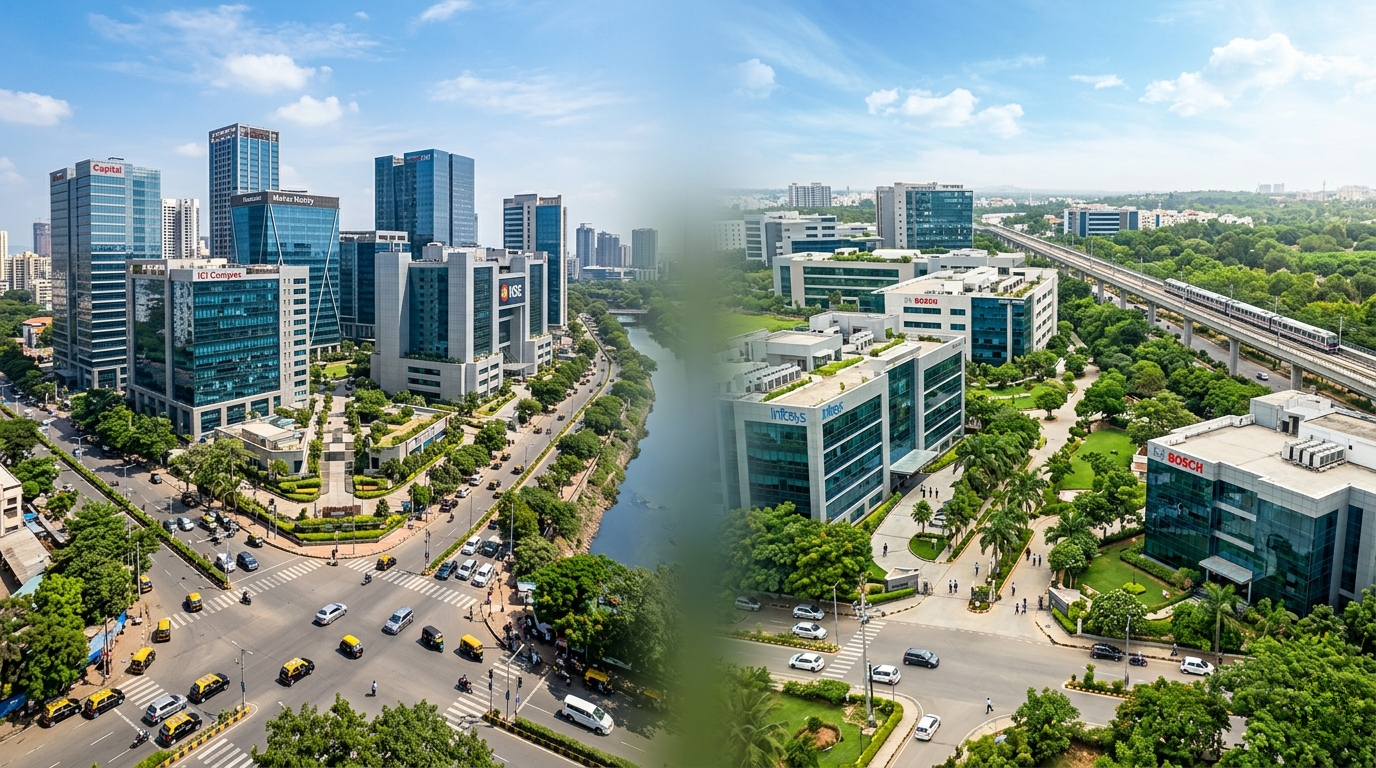
Maharashtra vs Bengaluru: Which City Builds Better Career Networks?
Engineering. Pharma. MBA. Law. The city you study in shapes the industry contacts you build. Here is the honest comparison that most students never see before they choose a college.
Most students pick a college based on rankings, fees, and hostel quality. Almost no one asks the question that actually determines career outcomes: Which city puts you inside the industry you want to work in?
Bengaluru is brilliant. For tech. If your plan is to join a software startup or a global IT firm, Bengaluru has the networks and the ecosystem. But if your field is pharma, finance, law, or core engineering, you are looking at the wrong map. Maharashtra, and specifically Mumbai, is where those industries are headquartered, regulated, and run.
Your college city is your first industry contact. This guide breaks it down field by field so you can choose wisely.
The Core Difference: Depth vs Breadth
Bengaluru is a single-industry city that does that one industry brilliantly. Maharashtra is a multi-industry state where pharma, finance, law, manufacturing, and engineering operate at national and international scale simultaneously.
The question is not which city is "better." The question is which city is better for your field. And that answer changes dramatically depending on what you are actually studying.
Maharashtra vs Bengaluru: Career Field Comparison
Where does each city give you the stronger industry network?
* Based on headquarters presence, industry density, and regulatory body locations as of 2026. Source: Industry data and fn.mahacet.org.
Pharma: Maharashtra Has No Equal
If you are studying pharmacy or pharmaceutical sciences, the network advantage in Maharashtra is not marginal. It is structural.
Maharashtra has over 3,800 pharmaceutical manufacturing units. The state accounts for 14% of India's total domestic pharmaceutical production. The companies that define global generics, Cipla, Sun Pharma, Glenmark, Lupin, and Wockhardt, all run their headquarters out of Mumbai. Their corporate strategy, regulatory affairs, and R&D leadership teams sit in the city.
When you study pharmacy in Maharashtra, your college placements, industry tours, and internship pathways all run through these firms directly. You attend the same industry conferences. You apply to the same companies your professors have consulting relationships with. That proximity is not something you can replicate from a city where these companies only have sales offices.
Law: Mumbai Is Where the Cases Actually Happen
For law students, the city of study shapes the type of law you can access. Mumbai gives law students something no other Indian city does: proximity to all three pillars of corporate and financial law simultaneously.
The Bombay High Court is one of the oldest and most active high courts in India, with a jurisdiction covering Maharashtra, Goa, and Dadra and Nagar Haveli. SEBI, the Securities and Exchange Board of India, is headquartered in Mumbai's Bandra Kurla Complex. The Reserve Bank of India's main offices are in Fort, Mumbai. The National Company Law Tribunal (NCLT) Mumbai bench handles the highest volume of corporate restructuring cases in the country.
Law students in Mumbai are not reading about these institutions in textbooks. They are doing internships inside them. That is a fundamentally different preparation for practice.
MBA and Finance: Mumbai Is the Only City That Matters
India's capital markets are in Mumbai. Both the Bombay Stock Exchange (BSE) and the National Stock Exchange (NSE) are headquartered here. Every major investment bank operating in India, Goldman Sachs, JP Morgan, Morgan Stanley, HSBC, has its India headquarters in Mumbai. The private equity, venture debt, and asset management ecosystems that surround these institutions are also concentrated in the city.
This is why JBIMS (Jamnalal Bajaj Institute of Management Studies) placement numbers look the way they do. The 2025 placement report for the MMS batch recorded an average CTC of 26.48 LPA, with BFSI and investment banking accounting for 42% of all offers. These are not numbers that happen because JBIMS is an exceptional college in isolation. They happen because JBIMS is physically inside the financial capital of India, and Goldman Sachs, McKinsey, Kotak, and Axis Bank can walk across the street to recruit there.
Bengaluru has MBA colleges with strong tech-sector placement records. But if your goal is finance, investment banking, capital markets, or consulting for non-tech industries, the recruiter density in Mumbai is unmatched anywhere else in India.
Core Engineering: Pune Changes the Conversation
For students of mechanical, automobile, manufacturing, or chemical engineering, Pune is in a separate category from any other Indian city, including Bengaluru.
Pune is India's auto and manufacturing hub. Tata Motors, Mahindra and Mahindra, Bajaj Auto, Thermax, Alfa Laval, and KPIT Technologies all operate major engineering facilities here. The city hosts more than 4,500 manufacturing units and has a strong culture of collaboration between engineering colleges and the industrial sector.
Bengaluru has electronics and aerospace engineering presence through ISRO, HAL, and DRDO. But for core mechanical, production, and automobile engineering, Pune's industry density makes it the stronger environment by a significant margin.
The Insight Most Students Miss
Most students treat college selection as a function of rankings, campus life, and fees. Very few students ask: "What companies are physically close to this campus, and will I have access to them during my degree?"
The answer to that question shapes your internships, your placements, your alumni network, and your first five years of employment. A college city is not just where you live for four years. It is the professional universe you enter when you graduate.
If you are studying in Bengaluru for a tech career, that city is well-matched to your goals. But if you are studying pharma, law, finance, or manufacturing engineering, the professional ecosystem you need to access is concentrated in Maharashtra. Studying there puts you inside that ecosystem from day one.
Apply to Study in Maharashtra: Timeline for 2026-27
How to Study in Maharashtra as an International Student
Maharashtra's single-window admission system for international students is managed through fn.mahacet.org. This portal covers NRI, OCI, PIO, CIWGC, and Foreign National candidates for admission to over 200 Maharashtra colleges across engineering, pharmacy, MBA, law, architecture, and other programs.
International students are exempt from MHT-CET. You do not need to sit for the common entrance test that domestic Maharashtra students take. Your admission is processed directly through the portal based on your academic qualifications and chosen category.
The total one-time registration fee is USD $1,200, split as USD $50 at provisional registration and USD $1,150 after receiving your eligibility letter. College tuition fees are paid separately and vary by institution and program, typically ranging from INR 4 to 35 lakh per year depending on the course.
Side-by-Side: Maharashtra vs Bengaluru by Study Field
| Field | Maharashtra | Bengaluru | Stronger For |
|---|---|---|---|
| Pharma / B.Pharm / M.Pharm | 3,800+ units, major HQs | Some biotech presence | Maharashtra |
| Finance / MBA | BSE, NSE, RBI, all major banks | Limited finance sector | Maharashtra |
| Law (Corporate / Financial) | Bombay HC, SEBI, NCLT Mumbai | Karnataka HC only | Maharashtra |
| Software Engineering | Strong, but not primary hub | Infosys, Wipro, global tech MNCs | Bengaluru |
| Core / Mech / Auto Engineering | Pune: Tata, Mahindra, Bajaj | HAL, ISRO (aerospace only) | Maharashtra |
| Startups (Tech) | Growing, but smaller ecosystem | Highest VC density in India | Bengaluru |
Career Networking Checklist: Make the Most of Studying in Maharashtra
Frequently Asked Questions
The Bottom Line
Bengaluru is an excellent city for one specific career path: technology. For everything else, pharma, finance, law, manufacturing, and core engineering, the industry infrastructure, the regulator presence, and the recruiter density are all concentrated in Maharashtra.
Your college city is your first industry contact. That is not a slogan. It is a structural fact about how careers are built. Choose the city that puts you inside the ecosystem you actually want to join.
International students can begin their Maharashtra application at fn.mahacet.org. The portal is free to explore and covers admissions across engineering, pharmacy, MBA, law, architecture, and more.
Ready to Build Your Career Network in Maharashtra?
200+ colleges. Pharma, finance, law, engineering. One portal. Applications open for 2026-27.
Apply Free at fn.mahacet.orgQuestions? Write to student@mahacet.org