Maharashtra vs the US for MBA: What Bahraini Students Need to Know Before Deciding

Nour had the spreadsheet open on her second monitor for three weeks. On the left: a two-year MBA at a ranked US business school, USD 120,000 in tuition, living costs in Boston or Chicago on top of that, and an F-1 visa that gave her two years of optional practical training before she had to figure out what came next. On the right: an MBA at a Mumbai or Pune institution, a fraction of the cost, and direct placement access into one of the world's fastest-growing economies. The MBA Maharashtra vs US comparison Bahrain students keep putting off is worth doing properly. This is that comparison.
The Cost Reality: US Tuition vs Maharashtra Government Fees
A two-year full-time MBA at a top-twenty US business school costs between USD 100,000 and USD 160,000 in tuition alone. Add living expenses in a US city and the two-year total comfortably exceeds USD 200,000 for most international students. Outside the top twenty, ranked US MBA programmes still run USD 60,000 to USD 90,000 in tuition for a degree that will need to compete hard in a job market where international students face significant visa-related hiring friction.
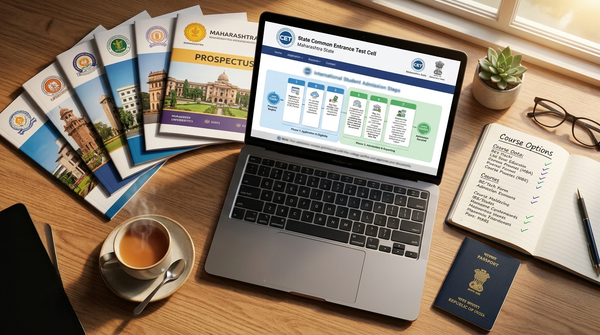
Maharashtra MBA programmes at government and government-aided institutions operate under regulated fee structures. The total cost for a two-year MBA, including tuition and living in Pune or Mumbai, is a fraction of even a mid-tier US programme. International students apply through fn.mahacet.org, the official Government of Maharashtra single-window portal, with a total administrative fee of USD 1,200 covering the full admission process.
The honest framing: a US MBA from a top-ten school is a different credential from a Maharashtra MBA, and the price reflects that. But a US MBA from a school ranked fiftieth is not obviously a better business education than a strong Mumbai institution at one-fifth the cost. That is the comparison most Bahraini students are actually making, and it deserves an honest answer.
Entry Requirements: GMAT vs the fn.mahacet.org Process
US MBA programmes at competitive schools require a GMAT or GRE score, typically above 650 for programmes ranked in the top fifty. They also require two to four years of professional work experience, letters of recommendation, essays, and interviews. The process is rigorous and time-consuming. Many Bahraini applicants spend six to twelve months preparing applications across multiple schools with no guarantee of admission.
Maharashtra MBA admissions for international students through fn.mahacet.org require a bachelor's degree with a minimum aggregate, documentation of academic credentials, and completion of the portal registration process. Work experience requirements vary by institution, with some Pune and Mumbai business schools giving preference to applicants with professional backgrounds without making it a hard requirement for admission.
There is no GMAT submission mandated at the portal level for foreign national students. The process is built for accessibility, not as a filter. Students who have a solid undergraduate record and clear professional goals but have not spent months on standardised test preparation have a real pathway through fn.mahacet.org that does not exist at comparable US institutions.
The Network Question: US Alumni vs Mumbai's Financial Ecosystem
The US MBA's most durable argument is its alumni network. A degree from Wharton, Booth, or Kellogg connects you to a global network of decision-makers in a way that is genuinely difficult to replicate elsewhere. If the career goal is investment banking on Wall Street or a leadership role at a Fortune 500 firm, that network is part of what the tuition buys.
Mumbai is India's financial capital and one of the fastest-growing financial centres in Asia. The Bombay Stock Exchange is Asia's oldest. The city's Bandra Kurla Complex hosts the Indian offices of Goldman Sachs, JPMorgan, Morgan Stanley, Barclays, HSBC, Deloitte, and McKinsey, among dozens of others. MBA students at strong Mumbai and Pune institutions do internships and final placements inside these firms, building networks inside organisations that are increasingly consequential in global finance.
For a Bahraini student whose career will run through the Gulf, South Asia, or emerging markets, a Mumbai MBA network may be more practically useful than a US alumni connection that is geographically and culturally distant from where the work actually happens.
Post-Graduation Career Paths From Both Destinations
A US MBA, depending on the school, opens OPT for up to three years in STEM-designated programmes, after which most international graduates need H-1B sponsorship to remain in the US. The H-1B lottery has become unpredictable, and many international MBA graduates from US schools return to their home regions within two to three years of graduating regardless of their initial plan.
A Maharashtra MBA graduate is positioned to enter the Indian job market directly, access Gulf hiring pipelines through established recruitment networks, or leverage their India experience as a credential in markets that are watching India's economic trajectory closely. The Gulf, East Africa, and Southeast Asia increasingly view India business experience as a genuine asset rather than a second-tier credential.
For Bahraini students who intend to build careers in the Gulf region, the return on a Maharashtra MBA, measured as income relative to investment, compares favourably once the USD 200,000 US cost is factored against realistic post-graduation salary trajectories in Bahrain, the UAE, or Qatar.
India's Economic Context: Why Studying Here Now Matters
India became the world's fifth-largest economy and is on a credible trajectory toward third by the early 2030s. Maharashtra accounts for roughly fifteen percent of India's GDP and is the most industrially productive state in the country. Mumbai hosts the headquarters of more Fortune 500 Indian subsidiaries than any other Indian city.
Studying business in Maharashtra in 2025 is not simply a cost arbitrage decision. It is a position in one of the highest-growth business environments on the planet during a period when that environment is attracting serious global capital. Students who build networks, language intuition, and market understanding in Maharashtra during their MBA graduate with contextual knowledge of a market that Gulf businesses are actively trying to understand and access.
That context is not something you can buy with a US MBA and two weeks of market research. It accumulates over two years of living, studying, and working inside the economy.
FAQ
Is an MBA from Maharashtra recognised for Gulf banking and finance careers?
MBA degrees from accredited Maharashtra institutions are evaluated by Gulf employers and professional bodies on their merits. Major Gulf banks and financial institutions, including those operating in Bahrain's financial centre, recruit from Indian business schools and are familiar with the credential landscape. Graduates from well-ranked Maharashtra institutions, particularly those with demonstrated placements at recognised firms, have successfully entered Gulf banking, consulting, and financial services roles. Employers in the region assess the institution's standing, the candidate's experience, and interview performance rather than applying a blanket country-of-study filter. Students should target institutions with verifiable placement records and, where possible, with MoU agreements with Gulf-region firms.
Nour closed the spreadsheet and opened the fn.mahacet.org portal. She is now in the final semester of her MBA at a Mumbai business school, completing a placement project with a financial services firm in Bandra Kurla Complex. She still knows what a Booth MBA costs. She also knows what her salary offer looks like and what her family did not have to borrow to make it happen.
If you are at the same spreadsheet moment, the place to begin is direct.
Apply at fn.mahacet.org. No agents. No middlemen. One government-backed portal.
Maharashtra is India's most connected state for international students. Over 3,000 colleges. Every discipline. One government-backed portal. No agents. No middlemen.
Apply now at fn.mahacet.org, the official Government of Maharashtra portal.
Follow us: Instagram: @admissiondeskedu YouTube: Edulab Educational Exchange Facebook: @admissiondeskedu