Stop Paying Education Agents: The Only Website International Students Need to Apply to Maharashtra
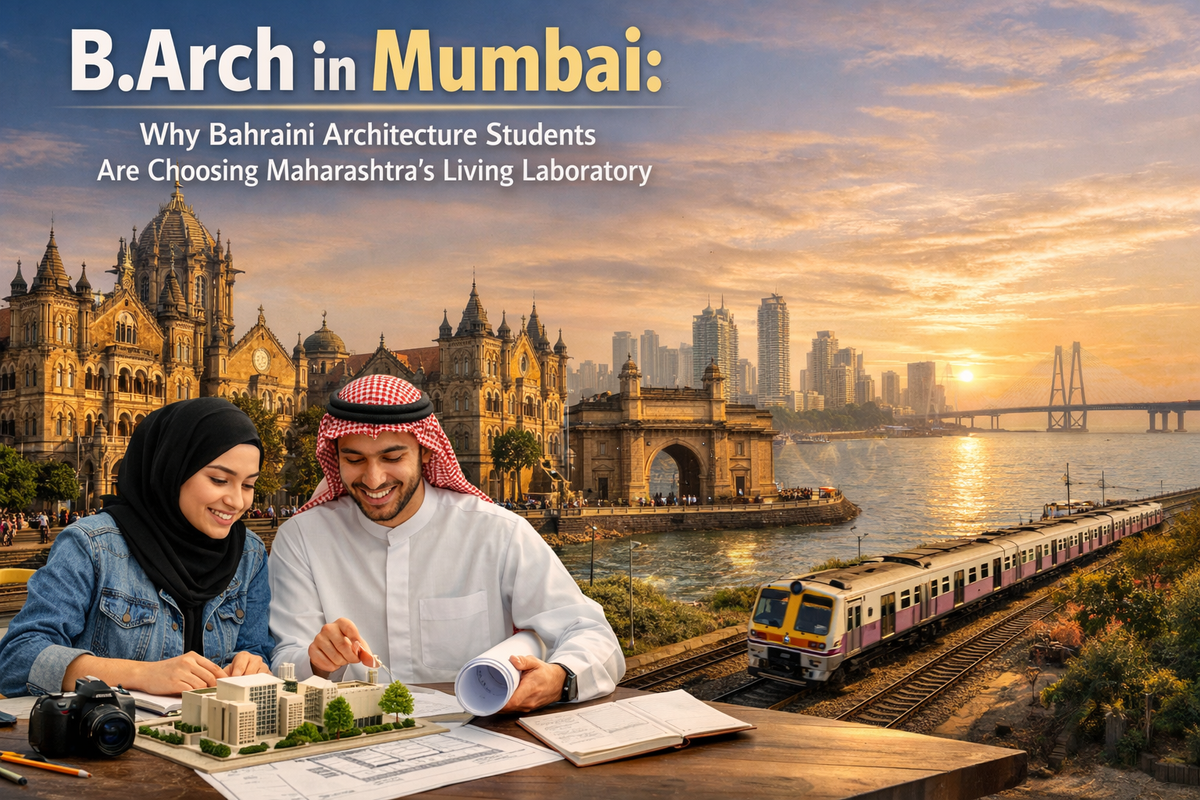
In Manama, architecture tells the story of Bahrain's soul. The wind towers that kept ancient homes cool before air conditioning existed. The coral-stone walls of the old city. The pearling stations where generations of Bahraini men left before dawn and returned with something the whole world wanted.
Layla grew up surrounded by that legacy. She understood, earlier than most people do, that a building is never just a building. It is a record of who a people were, what they valued, and what they wanted to leave behind.
She came to Mumbai to study B.Arch - Bachelor of Architecture - at a top Maharashtra institution. And she found something she did not expect: a city that understands legacy in the same way Bahrain does, but on a scale she had never encountered before.
In her studio, looking at the scale model she had been working on, she said it simply: Mumbai is a living laboratory.
This article explains what that means for architecture students - and why fn.mahacet.org is the only portal they need to get there.
Mumbai: The Living Laboratory
There is no city in Asia quite like Mumbai for the study of architecture. The reason is not one building, or one era, or one style. It is the collision of all of them - layered on top of each other across two centuries of extraordinary history - in a single, dense, walkable urban environment.
Victorian Gothic
Mumbai's Victorian Gothic buildings - the Chhatrapati Shivaji Maharaj Terminus, the High Court, the University of Mumbai's Rajabai Clock Tower - were built between 1860 and 1890 during the height of the city's cotton trade wealth. They were designed by British architects who took the Gothic Revival style of Europe and adapted it to a tropical climate: pointed arches that allowed hot air to rise, verandahs that shaded walls from direct sun, high ceilings that created natural convection cooling.
For architecture students, these buildings are not just beautiful. They are a masterclass in climate-responsive design - a lesson that is more relevant today, in the age of climate change, than it was when they were built.
Art Deco
Mumbai's Marine Drive is home to one of the largest collections of Art Deco buildings outside of Miami. Built during the 1930s and 1940s, these structures brought the geometric elegance of European modernism to a South Asian context - blending it with local motifs, materials, and the practical requirements of a humid coastal city.
UNESCO recognised this extraordinary collection in 2018, declaring the Victorian Gothic and Art Deco Ensembles of Mumbai a World Heritage Site. Layla studies in a city where walking to class can mean passing between UNESCO-listed buildings.
Contemporary and Sustainable
Mumbai is also one of Asia's most active contemporary construction markets. Glass towers, mixed-use developments, waterfront regeneration projects, and - increasingly - green buildings designed to meet international sustainability standards. Layla's B.Arch program integrates sustainable design, structural engineering, heritage conservation, and digital design tools - all in a city where every one of those disciplines is being practised at scale, right outside the studio door.
The Bahrain-India Architectural Thread
Layla made a connection during her studies that most people outside architecture would not immediately notice: Bahrain and India have been building alongside each other for five thousand years.
The ancient Dilmun civilisation - whose heartland was Bahrain - traded with the Indus Valley civilisation across the Gulf waters. Copper, dates, and timber moved in one direction. Carnelian beads, cotton textiles, and ideas in urban planning moved in the other. The cities of Mohenjo-daro and Harappa - with their sophisticated drainage systems, standardised brick sizes, and planned street grids - were contemporaries of Bahrain's own ancient settlements.
Later, the dhow-building tradition of the Gulf and the maritime architecture of India's western coast developed in close conversation with each other. The same timber. The same joinery techniques. The same understanding of how wood behaves in salt air and tropical sun.
When Layla sketches in her Mumbai studio, she is not working in a foreign tradition. She is continuing a conversation her civilisation has been having with India for millennia.
What the B.Arch Program at a Maharashtra Institution Covers
The Bachelor of Architecture is a five-year professional degree recognised by the Council of Architecture, India. At Maharashtra's leading institutions, the curriculum is structured to produce architects who can work anywhere in the world - and who understand both the technical and cultural dimensions of what they are designing.
The core program covers:
- Structural Engineering - the science of how buildings stand, flex, and survive seismic and wind loads. Essential for designing in both the Gulf and in Maharashtra, both of which face significant environmental engineering challenges.
- Heritage Conservation - how to study, document, preserve, and sensitively adapt historic buildings. Given Mumbai's UNESCO World Heritage status, students have access to conservation projects on buildings of genuine international significance.
- Sustainable Design - passive cooling, solar orientation, water efficiency, green building certification. Increasingly the most commercially valuable skill in the global architecture market.
- Digital Design Tools - Building Information Modelling (BIM), parametric design, 3D visualisation. The tools that every contemporary architecture firm globally now requires.
- Urban Planning and Landscape - understanding how individual buildings relate to streets, neighbourhoods, and cities. Layla is not just learning to design buildings. She is learning to design the spaces between them.
Designing for Anywhere - Including Bahrain
Layla is explicit about this: she is not studying in Mumbai to build a career in Mumbai. She is studying in Mumbai because it is the best place she has found to build the skills that will allow her to design anywhere - including Bahrain.
Bahrain is undergoing significant architectural transformation. The Bahrain Bay development. The expansion of Manama's waterfront. The preservation challenges of the old city's historic fabric. The demand for new buildings that honour Gulf architectural heritage while meeting international sustainability standards.
The architects who will design that transformation need to understand structural engineering at the highest level, heritage conservation in practice, and sustainable design as a technical discipline - not just a marketing term. Layla is learning all three. In Mumbai. At a Maharashtra institution. Through fn.mahacet.org.
How to Apply for B.Arch Through fn.mahacet.org
B.Arch - Bachelor of Architecture - is listed under the Technical Education category on fn.mahacet.org, the Government of Maharashtra's official single-window portal for international students.
Bahraini and other international students apply as Foreign National Students (FNS) through the following process:
- Step 1: Register at fn.mahacet.org and use the category checker to confirm your eligible student category.
- Step 2: Select B.Arch under the Technical Education tab. Browse available institutions, view their NAAC accreditation ratings, and check fee structures - all listed transparently before any application is submitted.
- Step 3: Upload your academic documents - 10+2 certificates or equivalent, passport, photograph, and any portfolio materials specified by your chosen institution.
- Step 4: Pay the official portal fees - USD 50 eligibility fee and USD 1,150 processing fee - through the CCAvenue payment gateway, which supports foreign currency conversion.
- Step 5: Receive your offer letter and begin the pre-arrival onboarding guidance provided through the portal.
No agent is required. No consultant is needed. The helpline at +91-9152252049 is available 10:00 AM to 6:00 PM IST for any technical queries, and email support is available at student@mahacet.org.
Frequently Asked Questions
Do Bahraini students need a portfolio to apply for B.Arch in Maharashtra?
Portfolio requirements vary by institution. Some Maharashtra architecture institutions require a portfolio of creative or design work as part of the application. Others assess applicants purely on academic results. The specific requirements for each institution are listed on fn.mahacet.org against the college profile. Students should review these before selecting their preferred institution.
Related Reading from Study in Maharashtra
- Bahrain and India: 5,000 Years of Connection - Why Maharashtra Is the Natural Choice
- Stop Paying Education Agents: The Only Website International Students Need
- MBA in Mumbai for Bahraini Students: Building Careers in India's Financial Capital
Mumbai is the only city in Asia where Victorian Gothic, Art Deco, sustainable design, and cutting-edge contemporary architecture coexist in one walkable environment. B.Arch at a top Maharashtra institution - listed under Technical Education on fn.mahacet.org - with transparent government fees and no agents required.
Apply now at fn.mahacet.org - the official Government of Maharashtra portal. Your studio awaits.
Follow us:
- Instagram: @admissiondeskedu
- YouTube: Edulab Educational Exchange
- Facebook: @admissiondeskedu