Getting Sick in India as an International Student: The Real Health Prep Guide Nobody Emails You Before You Land
Getting Sick in India as an International Student: The Real Health Prep Guide Nobody Emails You Before You Land
Health anxiety is one of the quietest but most powerful reasons a parent says no to studying in India. University websites list a clinic name and move on. This guide answers the four questions that actually matter — honestly, with real data instead of a clinic name and a shrug.
Is the water safe? Which vaccines actually matter versus which ones are just a long list nobody explains? What happens at 2am if something goes wrong with no family within a thousand kilometres? And does the health cover a student already has back home mean anything once they land? Four questions. Four direct answers — drawn from verified health and government sources, anchored to what the University of Mumbai, HSNC University, Savitribai Phule Pune University (SPPU), and Symbiosis International campuses actually look like on the ground.
The honest, city-specific answer: it depends more than people assume, and "just don't drink it" is the safest default everywhere.
In 2019, the Union Consumer Affairs Ministry commissioned the Bureau of Indian Standards (BIS) to test piped drinking water samples against IS 10500:2012 in India's state capitals. Mumbai stood alone — all 10 samples from Mumbai complied with all 11 BIS parameters. No other tested capital did so. Delhi, Kolkata, and Chennai had multiple failures on most parameters.
That sounds like straightforward good news for a Mumbai-bound student, and at the treatment-plant level it genuinely is. The caveat matters just as much: IS 10500:2012 defines quality at the point of supply. Even compliant source water can be contaminated in transmission due to aging pipe networks, leaks, and poorly maintained storage tanks — particularly during monsoon season. The practical rule that applies everywhere in India, Mumbai included: drink bottled or filtered water, use a personal water filter or UV purifier in your room, and treat tap water as fine for showering and brushing teeth but not for direct drinking. This is a habit, not a paranoia — one that most Indian residents themselves follow.
Most health pages hand new students a long official vaccine list without explaining which ones actually matter. The CDC and WHO recommend Hepatitis A, Hepatitis B, and Typhoid for most travellers to India — food- and water-borne illness is the most common health issue travellers actually encounter. Routine boosters including MMR and Tdap are also recommended. Malaria is a genuine consideration across lowland India, including Mumbai, making a conversation with a travel doctor about prophylaxis worthwhile.
But the single most important India-specific rule for international students — particularly those coming from Africa: India's Ministry of Health requires proof of Yellow Fever vaccination, taken at least 10 days before arrival, for travellers arriving from Yellow Fever-endemic countries. That list includes Sierra Leone, Ghana, Nigeria, and Ethiopia. This is a genuine entry requirement, not just a suggestion — and a generic "vaccines for India" article aimed at Western travellers will not flag it clearly.
Vaccine Checklist — Before You Board
Recommended by CDC and WHO for India travel. African students: note the Yellow Fever entry requirement carefully.
* Book a travel health appointment 4 to 6 weeks before departure. Your doctor will confirm the current endemic country list and whether your specific itinerary triggers additional requirements. Country-specific vaccine rules change — always check the current Ministry of Health Circular at mohfw.gov.in before travelling.
This is the scenario every anxious parent pictures, so it deserves a direct answer.
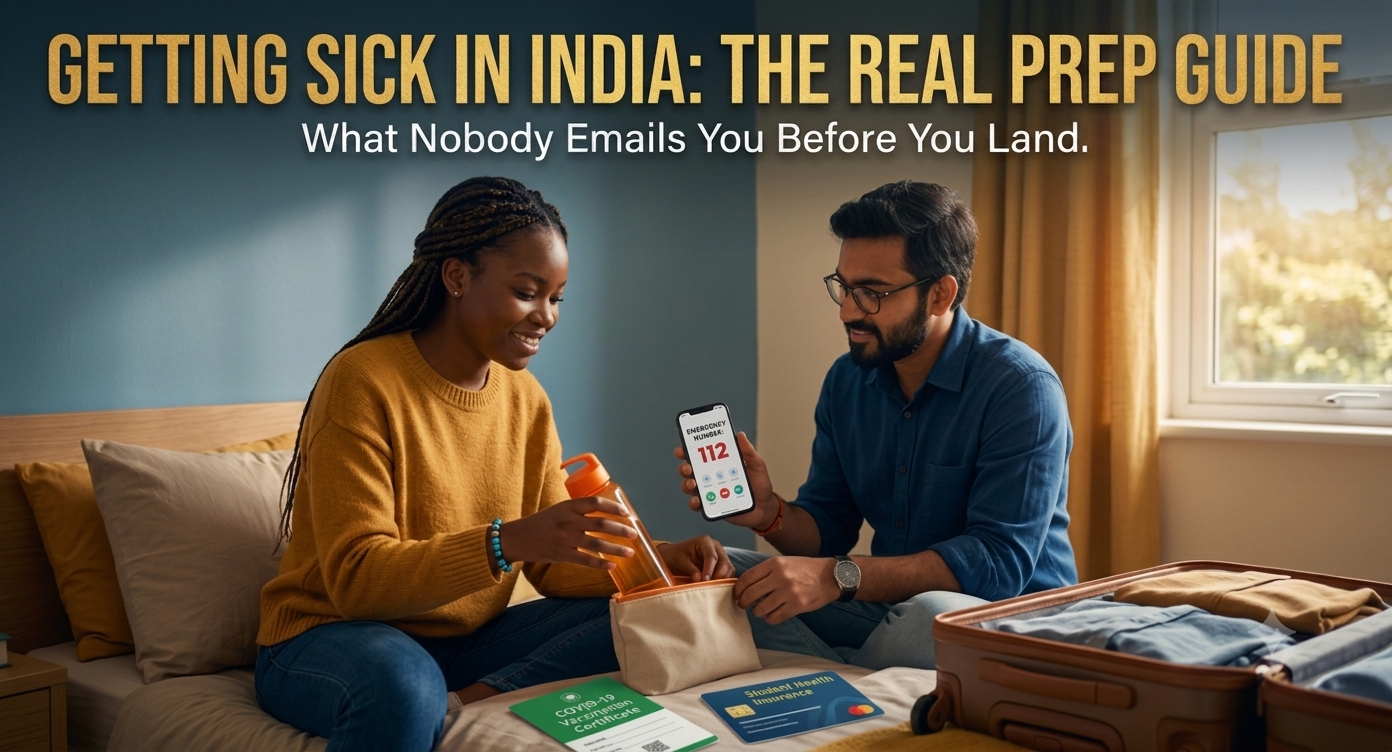
India has a unified emergency number — 112 — and a dedicated free ambulance number — 108 — active in most states 24 hours a day, 7 days a week. Both are worth saving in your phone before you need them, not after.
Your university's International Student Cell is your first point of contact in a medical emergency. Per studyinmaharashtra.org, individual colleges have International Student Cells that assist with accommodation, orientation, academic support, and cultural integration. At well-run institutions, this includes emergency protocols — most maintain relationships with specific nearby hospitals for exactly this reason.
On cost: routine care through a university's empaneled hospital network is typically low-cost or cashless if you are enrolled in the required group insurance scheme. A serious hospitalisation without insurance can be a genuine financial shock — which is exactly why the next question matters.
There is no single national law mandating that international students in India carry health insurance. In practice, this does not mean you are free to skip it. Most universities make enrolment in their own group health insurance scheme a condition of registration — typically costing somewhere in the ₹3,000 to ₹8,000 per year range, which is genuinely affordable relative to health cover in most other study-abroad destinations.
Whether your home country's insurance works in India depends entirely on your specific policy. Most standard domestic health plans from Sierra Leone, Ghana, Nigeria, Tanzania, or Ethiopia are not designed for overseas claims processing or India's private hospital network. The safe assumption is that you will need India-specific cover rather than relying on a home policy transferring seamlessly.
Three Questions to Email Your College Before You Arrive
These three questions take less than two minutes to send and provide information that can make a decisive difference in a genuine emergency.
Send This Email Before You Accept Your Offer
Frequently Asked Questions
Most colleges have on-campus clinics for routine care. Per fn.mahacet.org, student clubs, sports, and hostel facilities are listed as part of campus life — on-campus health support is standard at most large institutions in Mumbai and Pune. For emergencies beyond the campus clinic, the affiliated hospital network matters more.
No. The State CET Cell fee of USD $1,200 (USD $50 eligibility + USD $1,150 registration) is an admission processing fee — it does not include health insurance. Group health insurance is a separate enrolment at the college level, typically ₹3,000 to ₹8,000 per year, paid directly to the college.
Yes — in the private and multi-specialty hospitals that most large Maharashtra colleges are affiliated with, English is the standard medium of communication for medical consultations, documentation, and billing. In government hospitals, English may be less consistent at non-clinical levels, though medical staff are typically proficient.
Start at fn.mahacet.org. The free category check confirms your admission category — Foreign National, NRI, OCI, PIO, CIWGC, or Child of Seafarers — and takes two minutes. For support: student@mahacet.org · +91-9076000348 / +91-8879082178 (Monday to Friday, 10am to 6pm IST).
Health Prep Done. Now Apply to Maharashtra's 200+ Colleges.
37+ countries represented. International Student Cells at every campus. Mumbai and Pune's extensive private and multi-specialty hospital networks within reach of every enrolled student. The eligibility check is free.
Check Your Eligibility at fn.mahacet.orgQuestions? student@mahacet.org · +91-9076000348 / +91-8879082178 · Mon–Fri, 10am–6pm IST