Student Life in Mumbai and Pune: The Honest Guide for International Students
Student Life in Mumbai and Pune: The Honest Guide for International Students
Two cities. One state. Completely different student experiences. Here is what student life actually looks like in Maharashtra's two biggest university cities — the costs, the campuses, the commutes, the culture, and what international students who are already here say about it.
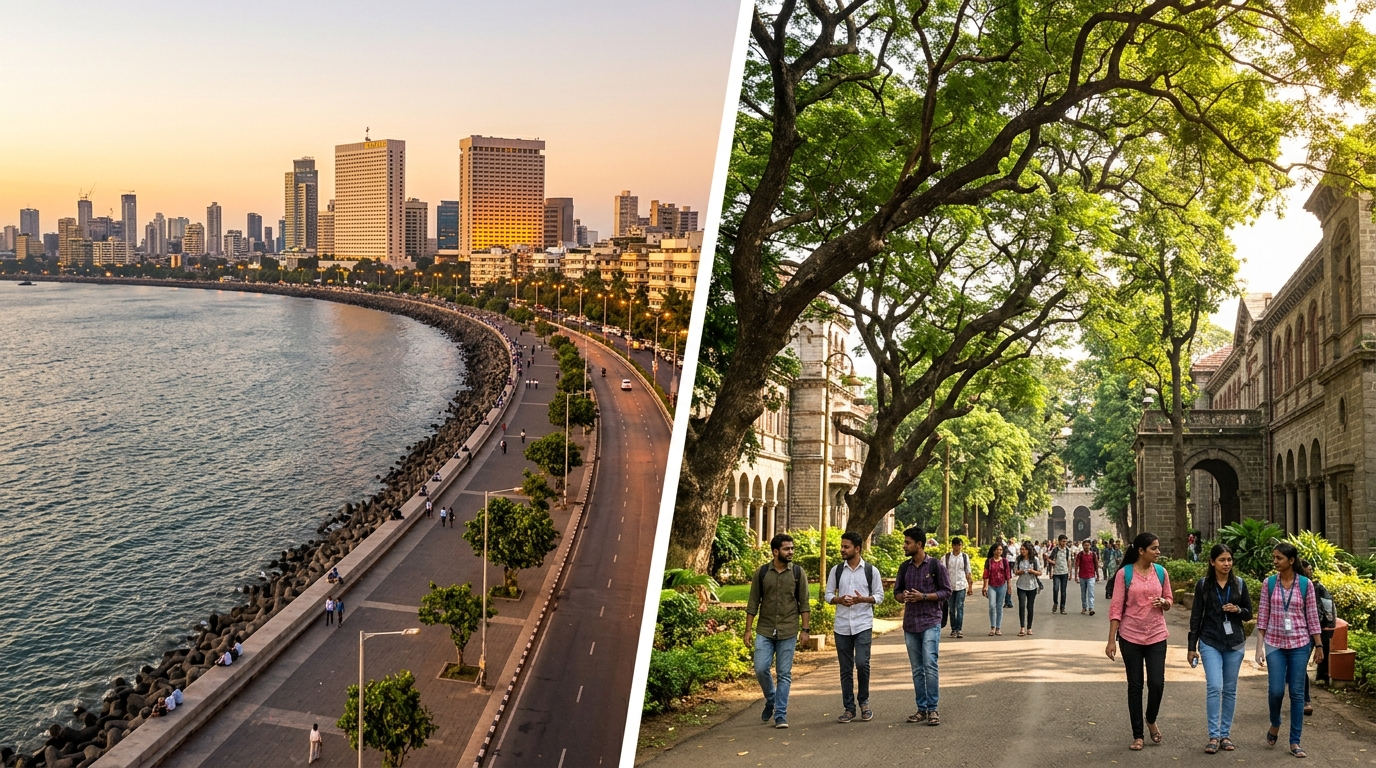
When international students arrive in Maharashtra through fn.mahacet.org, they are not just choosing a degree — they are choosing a city. Mumbai and Pune are Maharashtra's two largest university hubs, and they offer fundamentally different student experiences. Mumbai is India's financial and entertainment capital, a 21-million person metropolis where Bollywood, the Bombay Stock Exchange, IIT Bombay, and the University of Mumbai all share the same skyline. Pune is smaller, cooler, greener — the city its own residents and students from across the world call the "Oxford of the East." Both are worth understanding before you apply.
Mumbai — India's Dream City for International Students
Mumbai is like nowhere else in India. It is simultaneously India's Wall Street — home to the Bombay Stock Exchange, the Reserve Bank of India, NSE, and SEBI — and the headquarters of Bollywood, the world's most prolific film industry. For international students, this means an environment that is genuinely global: 300+ languages are spoken in Mumbai, and students from across 37+ countries study in the city's colleges each year.
Top institutions in Mumbai accessible through fn.mahacet.org include VJTI (est. 1887, ranked among India's top engineering colleges), JBIMS (India's top public B-school by placement), the University of Mumbai, ICT Mumbai, and IIT Bombay — all connected by Mumbai's local train network and metro system. Per fn.mahacet.org's Mumbai cost blog: the local train network is the lifeline of the city and makes cross-city commutes routine.
Popular student areas: Colaba, Churchgate, and Fort for south Mumbai colleges; Powai, Andheri, and Vile Parle for the IIT Bombay and western suburb belt; Navi Mumbai for newer campuses.
What Students Actually Spend in Mumbai — Monthly Budget
Source: fn.mahacet.org Cost of Living in Mumbai for International Students (2026 Guide). Reviewed by State CET Cell, Maharashtra.
| Expense | Typical Monthly Range (INR) |
|---|---|
| Hostel / PG rent | INR 8,000 – 25,000 |
| Food (mess + eating out) | INR 4,000 – 8,000 |
| Local transport | INR 500 – 1,500 (local trains are the lifeline) |
| Phone / internet | INR 300 – 600 |
| Total (approx.) | $350 – $600/month (USD equivalent) |
* Figures are approximate 2026 ranges and vary with area and lifestyle. Source: fn.mahacet.org Cost of Living in Mumbai blog, last updated June 2026, reviewed by State CET Cell, Maharashtra.
"I chose to study in Mumbai because it is the commercial capital of India, offering a dynamic environment shaped by both global and diverse local business activities. In this era of rapid globalization, Mumbai provides a unique opportunity to experience the rich cross-cultural diversity represented by people from all 28 states of India."
"Living in Mumbai has been a transformative experience — a vibrant, bustling metropolis that pulses with an unstoppable energy. This dynamic urban life is perfectly balanced by my experience on the IIT Bombay campus, nestled alongside the serene Powai Lake — an oasis of intellectual rigor and quiet reflection."
"Mumbai is big, not just in size but also in languages, cultures, professions, industries, people and everything. My fascination for this city remains as strong as ever."
Pune — The Oxford of the East
Pune has a different energy from Mumbai — more campus, more green, more manageable. It is India's IT hub, home to 4,000+ IT companies including TCS, Infosys, Wipro, and the Hinjewadi IT Park with 250,000+ professionals. For engineering, management, and science students, Pune's placement ecosystem is among the most active in the country.
Top institutions accessible through fn.mahacet.org include COEP Technological University (est. 1854, NIRF ranked), Savitribai Phule Pune University (SPPU, Top 10 Universities NIRF), Symbiosis International (NIRF #24 University), and MIT-WPU — all within Pune and accessible through Maharashtra's single-portal system. Pune's Metro opened in 2022 and now connects key student areas.
studyinmaharashtra.org confirms Pune and Nashik enjoy the most pleasant climate year-round in Maharashtra — a practical advantage for students arriving from tropical or warm-weather home countries adjusting to a new environment.
Mumbai vs Pune — Side by Side
Both cities serve students well. The choice depends on your course, your budget, and the kind of student environment you want.
Source: studyinmaharashtra.org city breakdown. fn.mahacet.org Cost of Living in Mumbai blog. All figures approximate; vary by area and lifestyle.
Campus Life — What Both Cities Share
Regardless of which city a student chooses, Maharashtra's international student experience through fn.mahacet.org comes with a consistent set of support structures confirmed by both sources.
From studyinmaharashtra.org — International Student Cells: "Individual colleges have International Student Cells that assist with accommodation, orientation, academic support, and cultural integration."
All courses for international students through fn.mahacet.org are delivered in English, confirmed by studyinmaharashtra.org. Student visa holders can undertake internships related to their course, but Indian student visas do not generally permit off-campus employment — per fn.mahacet.org's Mumbai cost blog: "Plan your budget on family or scholarship funding."
Practical Tips — Verified from fn.mahacet.org
Frequently Asked Questions
Pune is significantly more affordable. studyinmaharashtra.org confirms Pune monthly costs at $200–$400 versus Mumbai at $350–$600. Shared student rent in Pune starts from INR 5,000/month versus INR 8,000/month in Mumbai. For most students on a typical budget, Pune provides a better cost-to-quality-of-life balance.
Indian student visas do not generally permit off-campus employment, per fn.mahacet.org's Mumbai cost guide: "Plan your budget on family or scholarship funding." Student visa holders can undertake internships related to their course, per studyinmaharashtra.org. Nepal citizens have unrestricted working rights in India under the 1950 Indo-Nepal Treaty.
Yes. All courses for international students are taught in English, confirmed by studyinmaharashtra.org. In Mumbai and Pune specifically, English is widely used in education, business, and daily life in student areas. Mumbai alone has 300+ languages spoken, per studyinmaharashtra.org — making it one of the most multilingual cities in the world.
Yes. fn.mahacet.org is Maharashtra's single-window portal — one application gives access to 200+ colleges across all six major cities including Mumbai and Pune. You can apply to multiple institutions through the same registration. The eligibility check is free and takes two minutes.
Mumbai or Pune — Both Start at fn.mahacet.org.
One application. 200+ colleges. 37+ countries already represented. The eligibility check is free — confirm which city and course you qualify for in two minutes.
Check Your Eligibility at fn.mahacet.orgQuestions? student@mahacet.org · +91-9076000348 / +91-8879082178 · Mon–Fri, 10am–6pm IST