You Do Not Need Hindi to Study in Maharashtra - A Sri Lankan Student's Honest Answer
There is one question that shows up in almost every DM I receive from Sri Lankan students thinking about Maharashtra. It is not about fees. It is not about visa. It is not about whether the degree will be recognised back home.
It is: Can I survive there if I do not know Hindi?
I understand why. You are about to move to a country whose national language you do not speak, in a state whose regional language you also do not know, surrounded by people who have spoken both since childhood. That sounds like walking into a room where everyone knows something you do not.
I moved to Pune from Colombo knowing zero Hindi. Not a word. I had not prepared, had not taken a course, had not even downloaded a translation app before I left.
Here is what actually happened.
Pune is an English city
This surprised me more than anything. Within my first week, I realised that Pune functions almost entirely in English in every space that matters to a student.
My lectures were in English. Every single one. The professors addressed the class in English, wrote on boards in English, assigned readings in English. My classmates, most of them from Maharashtra, spoke to me in English without hesitation the moment they realised I was international.
Hospitals and clinics near university campuses in Pune are well used to international students. I visited a doctor twice in my first year. Both appointments happened entirely in English.
The apps are in English. The admin offices communicate in English. The emails from the university are in English. The forms I filled were in English.
If I had not told you I was in India, you would have assumed this was a university in Singapore or Malaysia.
What about Marathi?
Marathi is the language of Maharashtra, and Pune is a proudly Marathi city. You will hear it everywhere. At the market, on the street, in chai shops, in autos.
But here is the thing: nobody expected me to speak it.
In two years, I picked up perhaps fifty to sixty Marathi words. Enough to greet my landlady properly. Enough to order food without pointing. Enough to negotiate gently at the local vegetable market. That is genuinely the full extent of it.
I never felt shame about this. The people I encountered most days were warm about it. Several of them thought it was entertaining that I was trying at all. A few taught me new words unprompted, like it was a small gift.
Hindi I barely touched. I understood perhaps twenty words by the end of year two. Nobody made me feel that this was a problem.
The thing nobody tells you
Here is what actually surprised me, and I still think about it.
The Indian students wanted to practise English with me.
Not all of them. But a meaningful number. Students in my hostel, classmates in my course, people I met at campus events. They would strike up conversations, ask where I was from, and then very deliberately continue in English. Some of them told me directly that talking with international students was helping them build confidence for interviews and placements.
It was the opposite of what I had feared. I had imagined myself on the outside of a language barrier. Instead, my presence was actually useful to the people around me.
The real adjustment
I want to be honest because that is the whole point of this.
The language was not hard. What was actually hard was being far from home for the first time. Missing Colombo. Missing the specific way Sri Lankans talk to each other, the rhythm and the references. Missing my mother's cooking during long stretches of exam season.
But that is not a Hindi problem. That is a being-away-from-home problem. It happens to every student who studies internationally, in every country, in every language.
If you are genuinely worried about language, I would honestly suggest you stop worrying about it and start thinking about the harder questions: which course, which city, which budget.
What you can do before you leave
If you still want to prepare, one useful thing is to learn basic Marathi greetings. Namaskar. Dhanyavad. A few numbers. The effort itself earns you goodwill, even when the words come out wrong. It signals respect for the place you are choosing to study in. People notice.
Beyond that, you genuinely do not need to prepare linguistically. Your energy is better spent understanding Maharashtra's official admissions process.
One thing that helps
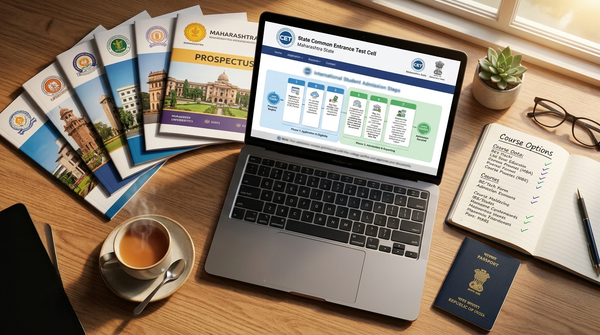
Everything about how to apply to Maharashtra's colleges as an international student is centralised on one government portal. Courses, fees, eligibility, application steps - all of it is on fn.mahacet.org. I have linked it in the description of the video that goes with this article.
If you are at the stage of deciding whether Maharashtra is the right choice, start there. The official information is clearer than anything an agent will tell you, and it is free.
Two years later
I think about the version of me that almost did not come because of a language she was afraid of not speaking.
That fear was understandable. It was also wrong.
Pune is one of the most internationally friendly student cities in India. The academic environment is in English. The community is warm. And the Marathi you will pick up along the way is a bonus, not a requirement.
If you are a Sri Lankan student who has got your A/L results and is now weighing your options, language should be the last thing stopping you. Start with fn.mahacet.org and let the actual information shape your decision.